

Unlock Success with Napoleon Hill Success Principles
Table of Contents
- Introduction: Why Focus Is Your Most Valuable Currency
- Chapter 1: Foundations of Success — Desire, Faith, and Definite Purpose
- Chapter 2: Napoleon Hill’s 13 Steps to Riches — Autosuggestion, Specialized Knowledge, Imagination, and More
- Chapter 3: Real-World Applications — Case Studies, Story-Based Lessons, and Modern Tools
- Chapter 4: Mindset Techniques — Visualization, Morning Routines, and Emotional Control
- Chapter 5: Protecting Your Energy — Boundaries, Environment, and the Power of Silence
- Execution Framework: Focus ? Execute ? Evolve
- Practical Playbook: Daily Routines, Metrics, and Accountability
- FAQ — Common Questions About Applying Hill’s Principles Today
- Conclusion: Become the Architect of Your Own Destiny
Introduction: Why Focus Is Your Most Valuable Currency
Here’s the core promise: focus is energy; energy, once directed, becomes power. And this power is the source of inner wealth—mental stability, emotional balance, self-discipline, and spiritual clarity—that supports lasting results in business, relationships, and life. In the sections that follow, I will translate Hill's foundational concepts into a modern, actionable roadmap: how to audit your inputs, redirect your energy, build your own success metrics, develop inner wealth, and execute consistently.

Chapter 1: Foundations of Success — Desire, Faith, and Definite Purpose
Desire: The Starting Line
Napoleon Hill begins with a simple truth: everything begins with desire. Not a wish or a vague hope, but a burning, defined objective. This “definite chief aim” gives your mind a single target to aim at—which dramatically improves your chances of hitting it.
How do you do it? Write one sentence: "My definite aim is to ______ by ______ (date) by doing ______." Make it specific, measurable, and emotionally charged. The clarity of this statement transforms idle longing into a plan the subconscious can begin to work toward.
Faith: The Internal Engine
Faith, in Hill’s system, is the practice of building belief through repeated affirmation and visualization. Faith is not wishful thinking; it’s conditioned certainty. The technique of autosuggestion (repeating carefully framed affirmations daily) aligns your conscious effort with subconscious conviction.
Practical exercise: Create a 60-second affirmation you can say every morning that encapsulates your definite aim and the emotion behind it. Example: "I am building X product that helps Y people. I accept consistent growth, and I will persist until the result is achieved." Repeat it with feeling. Record yourself. Play it back as part of your morning routine.
Definite Purpose: The North Star for Decision-Making
Once you have burning desire and replicable faith, you need a definite purpose. This single-purpose orientation reduces distraction. It helps you say "no" to things that don't move the needle and "yes" to the actions that compound.
Example: If your definite purpose is to build a sustainable online education business, then every choice—partnerships, content, funnels, tools—must be evaluated by whether it advances that purpose. This is how your attention becomes a productive currency rather than a drain.
Chapter 2: Napoleon Hill’s 13 Steps to Riches — Practical Breakdown
Hill's 13 steps are a blueprint. Below I present the most actionable of them, translated into modern practice and paired with tools you can use to implement them today.
1. Desire and Faith
We covered this in Chapter 1. This pair powers momentum. Transform desire into action by committing to small, consistent steps that prove to your subconscious you mean business.
2. Autosuggestion: Program Your Subconscious
Autosuggestion is the practice of deliberately influencing your subconscious through repetition. Write short, present-tense statements that reflect what you want, and speak them aloud. For stronger results integrate visual cues: a vision board, digital wallpaper, or recorded affirmations you listen to before sleep.
3. Specialized Knowledge
Hill emphasized that knowledge alone is inert; specialized knowledge applied with a plan achieves value. Identify one niche where you can become the best-informed practitioner. Invest time daily—read, take a course, practice. Today, specialized knowledge can be accelerated using modern platforms—courses, mastermind groups, and tools that automate outreach and learning.
Practical tool: consolidate what you learn into a single resource system (notes, an evergreen course, or a micro-ebook). Teaching what you know will accelerate mastery.
4. Imagination: Convert Thought Into Opportunity
Hill describes imagination as the workshop of the mind. Use imaginative exercises to create novel approaches to problems. Schedule "idea hours" where you brainstorm without judgment. Use a notes app to capture bizarre ideas—some will scale into profitable experiments.
5. Organized Planning and Decision
A plan is a living document. Hill taught that precise decisions backed by organized planning convert desire into fortune. Start with a minimum viable plan: 90-day goals and weekly priorities. Make decisions quickly; doubt and procrastination drain momentum.
6. Persistence and Mastermind Alliances
Persistence is the engine that records repeated action into identity. A mastermind is a group of peers who provide accountability, resources, ideas, and perspective. Hill’s original idea of the mastermind is a precursor to modern entrepreneurial communities and collaborative platforms.
Action step: Create a small mastermind of 3–5 committed peers. Meet weekly. Hold each other accountable for one measurable deliverable each week.

7. The Power of the Subconscious and the Brain
Your subconscious receives repeated input—habits, emotions, affirmations—and acts accordingly. Guard your inputs. Feed it discipline, gratitude, and clarity rather than distraction.
8. Sex Transmutation and Enthusiasm
Hill famously argued for transmuting physical energy into creative and productive drive. In modern terms: convert high-energy states into focused work and high-impact activities. Coupling enthusiasm with deliberate focus uplifts execution.
9. The Mystery of Capital—Adopt the Mental Habits of the Successful
Behavioral habits such as honoring commitments to yourself, mastering your emotions, protecting your mornings, and simplifying your environment compound into "internal capital"—the trust and energy that produce resilient results.
10. Overcoming Fear and Mastering Emotions
Fear is a productivity assassin. Hill taught that fear often stems from indecision and lack of clarity. Practically, regain control by acting despite fear. Small wins inoculate you against future fear.
11. The Role of Accurate Thinking
Separate facts from opinions. Make decisions based on real data and honest self-reflection. Accurate thinking reduces wasted energy on illusions and gossip.
12. The Habit of Saving and Building Financial Literacy
Wealth requires smart stewardship. Learn the basics of cash flow, reinvestment, and conservative planning so that when opportunities arrive you have the runway to capture them.
13. The Golden Rule and the Law of Attraction
Hill's framework ties ethics and unseen forces into success. When you help others, when your work is of service and value, networks open and resources flow. This isn't mystical—it’s a predictable effect of reputation, reciprocity, and consistent value creation.
Watch this comprehensive exploration of Napoleon Hill’s principles in action—presented by Think Rich Mindset Hub.
Chapter 3: Real-World Applications — Case Studies and Modern Tools
Theory without execution is a kind of cruelty. Below are practical case studies and modern tools that mirror Hill's principles, showing how to implement them in today’s fast-paced environment.
Case Study: The Quiet Founder
Imagine a founder who never chases likes and refuses to announce every move. She spends 90% of her energy on building a product that solves a real problem—test, iterate, and ship. For a year she builds in silence, refuses to compare her early traction to others, and uses a small mastermind for accountability.
Outcome: After consistent execution, referrals and organic growth begin to compound. People ask how she "suddenly" scaled. The truth is consistent daily building—Hill’s focus on discipline and persistence—made the accumulation inevitable.
Case Study: The Content Creator Who Built Inner Wealth
Another example: a creator replaced chasing validation with a creator-first metric. Each week they produce a short, educational piece that teaches a small skill, no matter the immediate views. They track progress using an internal metric: "Did I publish something that helps one person this week?" Over a year, this identity of "doer" turned into consistent audience growth, sustainable income, and genuine satisfaction.
Modern Tools That Echo Hill’s Principles
Hill’s focus on organized planning, specialized knowledge, and mastermind alliances has modern analogs. For example, tools that centralize communities, automate outreach, and offer learning systems help manifest these principles in practice. If you’re building courses, running mastermind groups, or automating follow-ups, consider using a platform that consolidates CRM, course delivery, and community features.
GFunnel is one modern example of an all-in-one system for entrepreneurs and creators. It helps people apply Hill’s principles—organized planning, mastermind support, and automation—into a single workflow. Explore GFunnel: https://www.gfunnel.com

Chapter 4: Deep Dive into Mindset Techniques
This chapter turns abstract concepts into daily routines and mental exercises you can apply immediately. Each technique is designed to build self-trust, emotional control, and clarity.
Technique 1: The Morning Hour Ritual
Protect your mornings like sacred ground. For the first 60 minutes after waking, avoid notifications and social feeds. Use a structured routine:
- 5 minutes: breathwork or quick meditation to calm the mind.
- 5 minutes: gratitude journaling—write three things you appreciate.
- 10 minutes: affirmation and visualization—speak or listen to your autosuggestion.
- 30 minutes: focused high-value work (the one task that moves the needle).
- 10 minutes: plan the day—list three wins you’ll target.
Why this works: the first hour anchors your energy. It builds discipline and ensures your mental state dictates the day rather than external notifications.
Technique 2: The "One Thing" Priority System
Ask each morning: "What is the one thing that, if completed today, moves my life forward?" Do that task first, uninterrupted. This enforces deep work and aligns time with your definite aim.
Technique 3: Redirecting Comparison into Action
Every time you feel the pull to compare, stop and act. Do one push-up, write one paragraph, or call one prospect. Immediate action kills envy because it shifts focus from them to you. The mind cannot compare and create simultaneously.

Technique 4: Visualization + Implementation Loop
Visualization without action creates fantasy. Pair imagination with immediate implementation. If you visualize a product launch, take one micro-action within the hour: draft the headline, reach out to a potential partner, or sketch a landing page. This loop turns images into reality.
Technique 5: Emotional Control Practice
Practice responding rather than reacting. When provoked, breathe, count to five, and answer with purpose. Replace gossip, anger, or complaint with constructive questions: "What can I learn?" or "What action will improve this?" This conserves energy for creation.
Chapter 5: Protecting Your Energy — Boundaries, Environment, and Silence
Energy protection is often overlooked in productivity conversations but it’s the pivot point of sustained success. When your energy leaks, your output collapses.
Audit Your Inputs
Do a 48-hour audit on what you consume. Note which social accounts, conversations, and feeds energize you and which ones consistently drain you. Unfollow, mute, or distance yourself from anything that triggers envy, doubt, or distraction.
Create an Intentional Environment
Clear the clutter—physical and digital. A clean workspace invites a clear mind. Reduce notifications to essentials. Use Do Not Disturb blocks. Make your space a tool for focus rather than a source of noise.
Choose Your Circle
Energy is contagious. Surround yourself with people who inspire growth. Join focused communities that hold you accountable. If you’re building a business or product, join niche communities where creators are actively building and sharing, not complaining or chasing shortcuts.

Boundaries Are Gates, Not Walls
Learn to say "no" to meetings, events, and requests that steal time from what matters. Every yes to something unimportant is a no to something valuable. Boundaries are an act of self-respect; they are essential to protecting the momentum Hill calls persistence.
The Power of Silence
Silence conserves energy. Not every thought requires expression and not every conflict deserves your voice. Practice selective response and you’ll find clarity, confidence, and creative capacity increase.
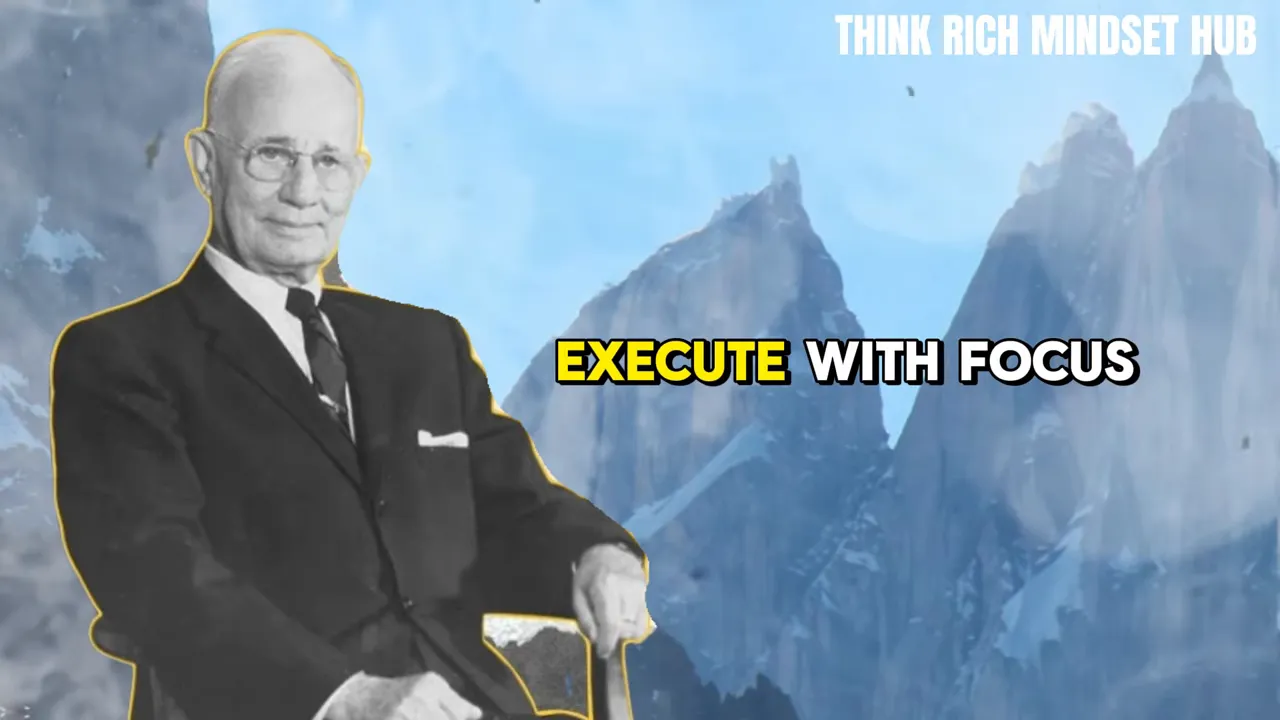
Execution Framework: Focus ? Execute ? Evolve
Hill’s work is not an arbitrary checklist; it’s a cyclical formula. I summarize it into three core verbs that form an everyday operating system:
1. Focus
Identify the one priority that accelerates your mission. Audit inputs and align environment to that aim.
2. Execute
Turn the priority into a daily system. Act even when uninspired. Build discipline through repetition. Replace "I feel like it" with "I do it anyway."
3. Evolve
Reflect, adapt, and upgrade. As you execute, the results give you data. Use that data to refine your plan. Let your identity change: from the person who hopes to the person who produces consistently.

Practical Playbook: Daily Routines, Metrics, and Accountability
Below is a practical week-by-week system for applying Hill’s ideas in measurable ways.
Daily Routine (Start Here)
- Morning (60 minutes): Breathwork, gratitude, affirmation, 30 minutes of deep work on your one thing.
- Midday (15 minutes): Check-in—did you move the one thing forward? Make a small course correction.
- Evening (15–20 minutes): Reflection—journal what went well and what to improve tomorrow.
Weekly Routine
- Weekly Planning (Sunday or Monday): Decide the weekly "one thing" and three priority tasks that support it.
- Mastermind (Weekly): Meet with 3–5 peers. Share progress and ask for one piece of help.
- Learning Block (2 hours): Invest focused time in specialized knowledge related to your niche.
Quarterly Routine
- 90-Day Review: Where did you progress? What habits need tightening? What relationships or inputs must change?
- Re-declare your definite purpose or refine it if necessary.
Metrics That Matter
Create your own scoreboard based on Hill’s advice: progress, discipline, and purpose. Instead of relying on external recognition, ask:
- Did I complete my one thing today?
- Did I keep my promise to myself this week?
- Have I added to my inner wealth (discipline, gratitude, focus) this month?
These internal metrics create a feedback loop that strengthens self-trust. Over time, external rewards follow.
Turning Pain Into Power: Why Discomfort Is Your Greatest Teacher
Pain is not punishment; it’s initiation. Hill emphasized that every success story includes seasons of struggle. Those seasons build grit. When you stop resisting pain and start studying it, each setback becomes feedback. Each failure becomes a lesson in resilience.
Actionable mindset shift: When something goes wrong, ask three questions: What happened? What did I learn? What will I do differently next time? This simple triad converts emotional reaction into tactical growth.

How to Build a Mastermind That Actually Works
Hill’s mastermind principle is foundational. A mastermind isn’t just a networking group; it’s a curated alliance of accountability, specialized knowledge, and mutual uplift. Here’s how to build one that produces results.
- Keep it small: 3–5 people maximum for intense accountability.
- Choose members with complementary skills and aligned ambition.
- Agree on outcomes and a cadence: weekly meetings, 30–60 minutes, with a clear ask and a measurable deliverable.
- Rotate roles: someone facilitates, others offer focused feedback and practical help.
- Use a shared system for tracking progress—simple spreadsheets or a community tool you already use.
When made consistent, the mastermind becomes a force multiplier: ideas, accountability, and resources combine to shorten the path to achievement.
FAQ — Applying Napoleon Hill’s Success Principles Today
What is the "definite chief aim" and how do I create one?
The definite chief aim is a single, clearly defined objective that guides your decisions. Create one by writing a short statement with a deadline, the specific result you want, and the actions you will take. Repeat it daily with conviction until it becomes your operating aim.
How does persistence lead to success?
Persistence compounds. Every time you follow through when you don't feel like it, you reinforce self-trust and grow momentum. This habitual follow-through turns small actions into a mountain of results over time.
How can I stop comparing myself to others?
Shift from comparison to creation: every time comparison arises, immediately take a micro-action—write a paragraph, make a call, or perform a short workout. Build your own metrics of success focused on improvement rather than approval.
What is autosuggestion and how do I use it effectively?
Autosuggestion is repeating short, present-tense affirmations that reflect your goals. Use them daily—morning and night—paired with visualization and emotion. The repetition programs your subconscious to look for opportunities aligned with your aim.
Where can I apply these principles using modern tools?
Use platforms that centralize learning, automation, and community. For creators and entrepreneurs looking to implement Hill’s principles—organized planning, mastermind collaboration, and automation—visit GFunnel: https://www.gfunnel.com
How long before I see results?
There is no universal timetable. What matters is consistent execution. Focus on winning the day. One percent progress every day compounds into visible change within months. The “overnight success” often follows years of unseen consistency.
Conclusion: Become the Architect of Your Own Destiny
Napoleon Hill captured a truth that transcends eras: success is built inside-out. It begins with clarity of purpose, is powered by faith and disciplined action, and is sustained by inner wealth—self-respect, emotional control, and a protected focus. When you choose to guard your energy, to build in silence, and to persist through pain, the external world rearranges to your inner standard.
Here’s my closing charge: stop waiting for validation, permission, or perfect conditions. Be the person who shows up when no one is watching. Define your aim, align your environment, protect your mornings, and commit to a system of daily execution. Over time, consistent actions will compound into the life you envisioned.
If you want to take practical steps right now: declare one definite aim for the next 90 days, join or form a small mastermind, and protect your first hour each morning. If you're building online—courses, communities, or products—consider tools that consolidate community, automation, and learning into a single flow. Visit GFunnel to explore an all-in-one approach that echoes these principles: https://www.gfunnel.com
Now go and build a life that refuses to be denied. Lock in. Level up. Move with power, precision, and peace. The world will notice only after you stop seeking approval and start producing relentlessly.