Mental Toughness Explained: Resilience & Business Automation
Table of Contents
- Introduction: Why mental toughness matters for life and business
- Chapter 1 — The Model: Defining mental toughness
- Chapter 2 — The Four Components: Tolerance, Fortitude, Resilience, Adaptability
- Chapter 3 — Real-world examples and what they teach us
- Chapter 4 — Making it actionable: practices to develop each component
- Chapter 5 — Business alignment: apply mental toughness to scaling with GFunnel
- Deep dive — GFunnel features that turn toughness into systems
- FAQs
- Conclusion: How to choose to behave when bad things happen
Introduction: Why mental toughness matters for life and business
I define mental toughness like this: the probability that a bad thing will change how you act in a way that is against your long-term goals. That definition matters because it turns an abstract concept into something measurable and improvable. Mental toughness isn’t binary—you don’t either have it or not. It’s a continuum, and it breaks down into four specific, trainable skills.
Why bring this up on a business-focused post? Because how you handle emotional disruption directly impacts your company and your team. An entrepreneur who lets setbacks dictate short-term, destructive decisions will see a business decline even if the market is favorable. Conversely, an entrepreneur who keeps acting toward the goal—using tools, automation, and systems to offload stress—builds compounding advantage.
Chapter 1 — The Model: Defining mental toughness
Start with a simple behavioral model. Imagine how you normally act. Then imagine a bad thing happens—anything that goes against your preferences. How does your behavior change, and what happens next?
There are three measurable moments in time here: (a) the change when the bad thing strikes, (b) the time it takes to recover back to a baseline, and (c) what baseline you settle into afterward. From that we get four components of mental toughness.
- Tolerance — how much negative input you can take before your behavior changes (how long your fuse is)
- Fortitude — how intense the behavior change is when you do snap (how deep you go)
- Resilience — how quickly you return to baseline
- Adaptability — whether your new baseline is higher, the same, or lower than before
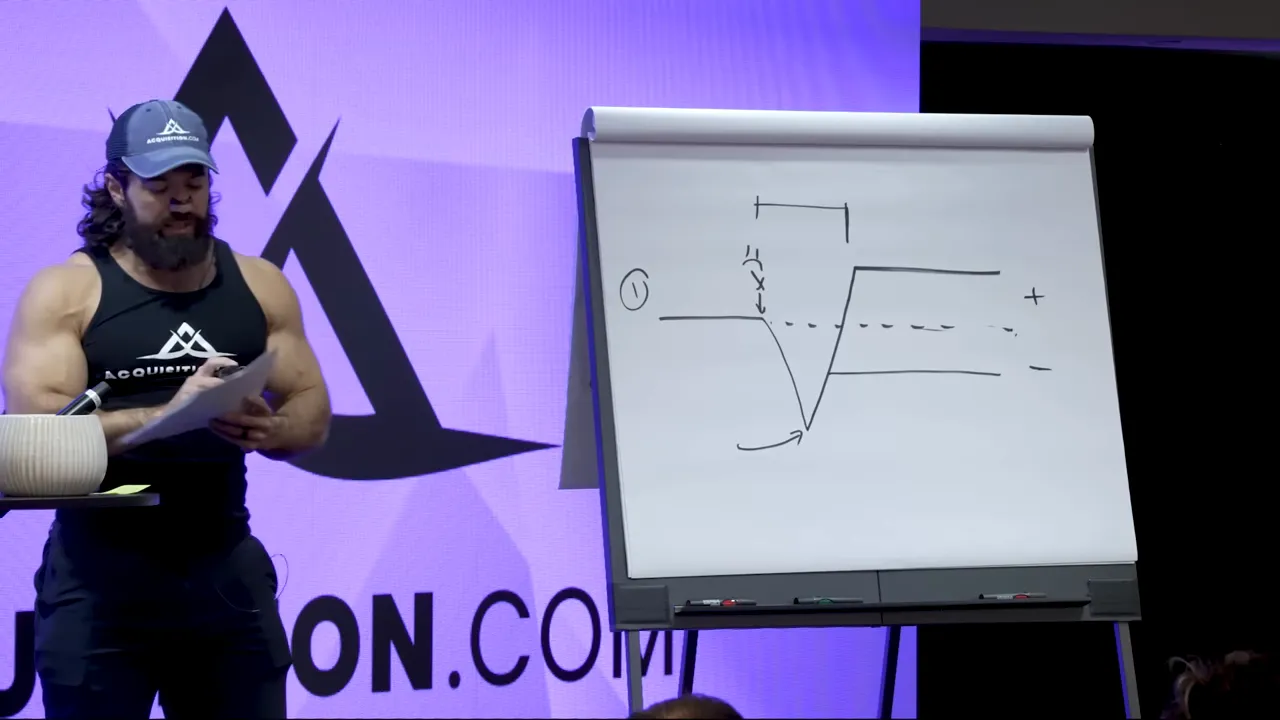
That’s it. Four components. Each is a continuum. Each can be measured subjectively by rating yourself and tracking outcomes. Each can be intentionally improved and trained. And when you treat mental toughness like a set of skills rather than an identity, you get the freedom to improve.
Chapter 2 — The Four Components: Tolerance, Fortitude, Resilience, Adaptability
Tolerance: How long is your fuse?
Tolerance is the amount of hardship, or the number of hardships, you can endure before your behavior changes. If you have a long fuse, everyday setbacks don’t rock your boat. If your fuse is short, a tiny inconvenience derails you. The practical implication: build friction between stimulus and reaction. Practice moments of non-reactivity. Choose how long you will suffer rather than letting the event choose for you.
Fortitude: How deep do you fall when your fuse is hit?
Fortitude is the intensity of behavioral change after you cross your tolerance threshold. When you do snap, do you take a breath and return to work, or do you quit, spiral, and make irreversible choices? Fortitude is often where people's stories go off the rails: a single moment where decisions compound into catastrophe. Fortitude is a matter of stopping the first bad decision from becoming the fifth.
Resilience: How quickly do you get back?
Resilience is the time it takes to recover to baseline after a behavior change. Some people bounce in minutes; others take months or years. There’s a dangerous cultural myth that recovery duration equals love, or that suffering length proves something noble. It doesn't. You can love intensely and choose an adaptive recovery that allows you to live effectively. Resilience is trainable because you can separate how you feel from how you act.
Adaptability: Does the experience make you better or worse?
Adaptability is the post-recovery baseline. If you stabilize higher than before, you adapted upwards—you let the hardship beat strength into you. If you stabilize the same, you were impervious. If you stabilize lower, the hardship beat the strength out of you. Notably, any permanent baseline change—up or down—is technically traumatic: behavior changed permanently because of an aversive stimulus. Trauma isn't always bad in the sense that you can become stronger; the point is that the event taught your nervous system a new rule. The goal is to ensure the lesson strengthens you, not weakens you.
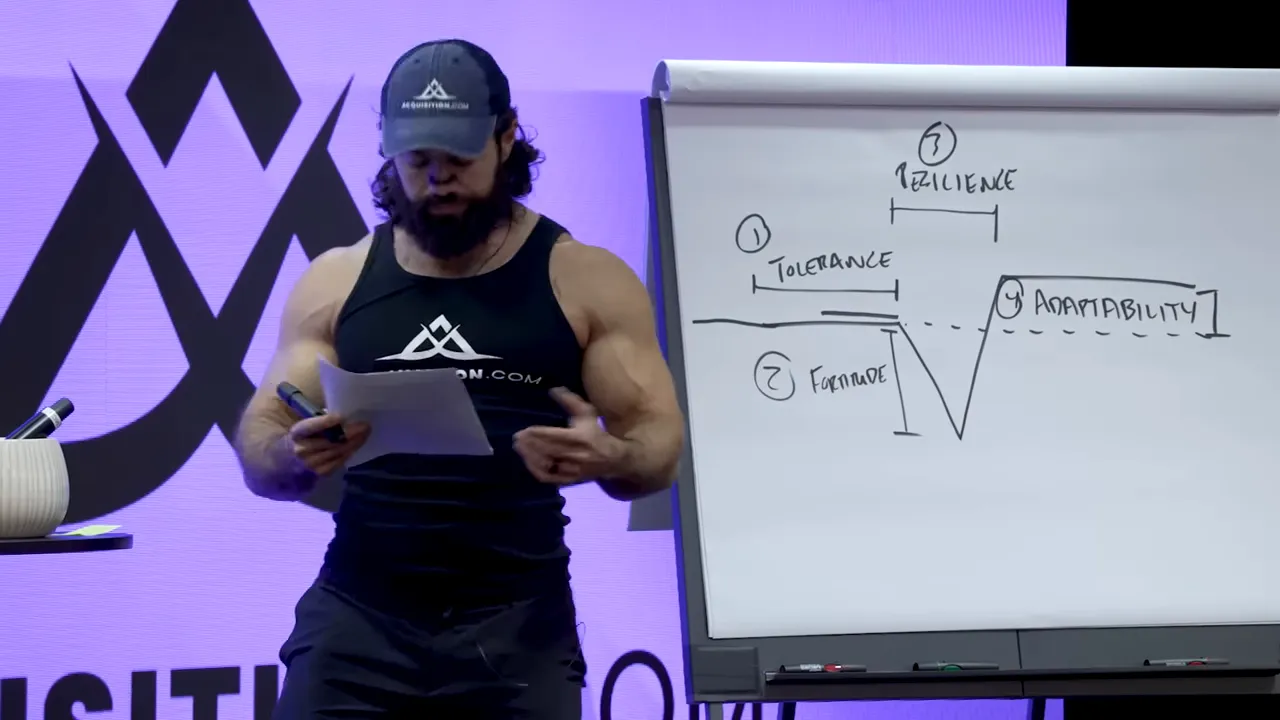
Once you accept this model, you can view mental toughness as a vector of four numbers. That’s powerful. It turns self-improvement from vague platitudes ("be tougher") into targeted practices.
Watch how disciplined responses compound: a short talk on mental toughness and actionable strategies.
Chapter 3 — Real-world examples and what they teach us
Let’s explore extremes and middles so these aren’t just abstractions.
The 10/10: Maxed-out mental toughness
Imagine someone who scores 10/10 on all four components. Their tolerance is huge—almost nothing bothers them. When something does, the behavioral change is negligible. They recover almost instantly, and the experience becomes growth. Life happens for them, not to them. That person is rare, but they’re built by repetition and deliberate practice.
The 0/10: The other extreme
Now imagine the opposite. Very small triggers set them off. When triggered, they make extreme decisions. They stay down for long stretches. They stabilize at a new, lower baseline—lost income, damaged relationships, addiction, or chronic underperformance. Life happens to them.
The middle: combinations and common patterns
Most people are somewhere in the middle. Some have long fuses but fall hard when they snap (high tolerance, low fortitude). Others get upset easily but recover quickly (low tolerance, high resilience). Identifying your pattern matters because each pattern requires different remediation. You can’t fix fortitude by meditating more if your problem is resilience. You need targeted practice.

These examples should feel familiar because they’re descriptions of people you know—including past versions of yourself. The practical question is: which one are you, and which one do you want to become?
Chapter 4 — Making it actionable: practices to develop each component
Here’s the part most people skip: concrete actions. If you want to increase your score on any of these four components, make a plan and practice. Below are specific exercises, mental frameworks, and simple behaviors you can start tonight.
Increase tolerance
- Deliberate exposure: place small inconveniences into your day intentionally—traffic, long lines, delayed emails—without changing behavior. Notice the discomfort. Allow it to exist.
- Reframe control: when someone says or does something you dislike, pause and decide whether you want to "hand them the keys." Remind yourself: I control my behavior.
- Anchor rules: create non-negotiable rules for how you’ll behave regardless of mood—e.g., "I don’t answer angry messages between 10pm-6am," or "I never quit on a first failure."
Increase fortitude
- Slippery slope audits: the moment you notice a behavioral drift, perform a quick inventory: what’s the next poor decision if I continue? Remind yourself of the previous times the slope led to bigger issues.
- Delay tactics: require a minimum delay before irreversible action (24-72 hours to quit a job, sign divorce papers, or fire someone in anger). Use the delay to consult a trusted advisor.
- Micro-wins: purposely do small acts of strength immediately after a trigger (make your bed, respond kindly, go for a walk). These reverse momentum.
Increase resilience
- Return to baseline rituals: decide what “baseline” means and create a checklist to achieve it. For example: shower, workout, send three emails, make one sales call. Do these even if you don’t feel like it.
- Break the feeling-action link: practice doing the baseline actions regardless of emotion. Over time the gap between feeling and acting narrows.
- Timeboxing recovery: give yourself a contained period to grieve or process (e.g., 2 hours or 2 days), then resume baseline actions.
Increase adaptability
- Post-trauma analysis: after a hard event, ask "How can this make me better?" List three tangible improvements you’ll pursue.
- Character framing: imagine you’re the protagonist in a movie. What would the hero do next? Emulate that behavior rather than the victim.
- Convert guilt/shame into growth: guilt (you broke your own rules) and shame (you broke others’ rules) are useful only if they change behavior. After they’ve done their work, let them go.
These practices aren’t about numbing feelings. Far from it. You should feel whatever you need to feel. The point is to separate feelings from behaviors. You can feel devastated and still choose actions that preserve who you want to be.

Chapter 5 — Business alignment: apply mental toughness to scaling with GFunnel
Here’s the bridge: the same model you use to manage emotional response is the one you use to run a business. When your company faces setbacks—ad campaigns that underperform, product launches that fail, churn spikes—how does your behavior change? Does one setback cause you to quit marketing, fire your team, and double down on a poor play? Or do you have systems that keep the business acting towards long-term goals?
Automation, centralized tools, and repeatable processes increase organizational tolerance, fortitude, resilience, and adaptability. Let me show you how the right platform—an all-in-one stack—does for your business what deliberate practice does for your mind. GFunnel is an ecosystem built to help entrepreneurs channel success by turning human fragility into mechanical advantage. It includes Lead Connector (CRM and lead management), Flows AI (workflows and automations), AI-powered contract management, drag-and-drop website builders, and CRM solutions that replace the costly, disjointed tool stack most entrepreneurs struggle with.
If you’re an entrepreneur trying to scale while dealing with normal life chaos, here’s why an all-in-one platform like GFunnel helps you perform like someone who’s trained their mental toughness:
- Tolerance via systems: with centralized processes (https://www.gfunnel.com/automation-home and https://www.gfunnel.com/crm), day-to-day setbacks don’t require ad-hoc fixes. Systems absorb shocks so your behavior doesn’t have to change when the email server goes down or a client delays payment.
- Fortitude through guardrails: templates, approval workflows, and automated escalation prevent one bad decision from cascading into many. For instance, AI-powered contract management and flows can prevent you from signing away critical protections in a moment of weakness.
- Resilience through rapid recovery: analytics and real-time dashboards let you spot trends and revert quickly. Instead of staying down for months because you missed a metric, you get notified, diagnose, and act.
- Adaptability as growth: with integrated testing, landing page variations, and CRM insights, every failure becomes a controlled experiment that makes the product or offer better.
If you want to start building a business that behaves like a person who’s trained their response system, consider centralizing your operations in one platform rather than gluing together ten tools. You can create an account in less than a minute at https://www.gfunnel.com/create-account and begin building processes that make your business more robust to stress.
How Hormozi’s strategies map to GFunnel
My business playbook has always leaned on a few core ideas: solve real pain, make offers so compelling people can’t refuse them, and scale through simplicity. GFunnel is designed to help you execute those principles:
- Solve real pain: Use GFunnel’s CRM to discover friction points in customer journeys, then use Flows AI to fix them automatically (https://www.gfunnel.com/automation-home).
- Create irresistible offers: Use analytics to validate your offers quickly. A good offer is validated by demand; GFunnel helps you track conversions and iterate fast.
- Scale through simplicity: Replace a half-dozen vendors with one ecosystem. Less context switching equals fewer opportunities for human error when you’re under stress.
When the business environment surges or collapses, the platform reduces the amplitude of the emotional rollercoaster you feel as a founder. And lower amplitude means you act more deliberately. That’s mental toughness applied at the organizational level.
Deep dive — GFunnel features that turn toughness into systems
Below is a practical feature breakdown and how each maps to the four components of mental toughness. I’ll also show how to implement a basic workflow that increases organizational resilience in measurable ways.
Lead Connector: centralize your leads
Lead Connector is the CRM core of GFunnel. It brings contact records, conversation threads, and conversion metrics into one place. For entrepreneurs this matters because lost context causes emotional responses. If leads are scattered across inboxes, Slack, and spreadsheets, when sales drop you react emotionally. A consolidated CRM increases tolerance by reducing avoidable surprises.
- Key features: unified contact view, automated tagging, lifecycle stages, and pipeline management.
- How it helps fortitude: templates and approval systems prevent hasty outreach that can alienate customers during crises.
- Start point: sign up at https://www.gfunnel.com and navigate to the CRM section to import contacts and set up a pipeline.
Flows AI: automate responses and workflows
Flows AI creates automation that handles repetitive tasks—follow-ups, reminders, conditional logic, and segment-based campaigns. When the unexpected happens, automated flows prevent neglect and inconsistent communications, increasing organizational resilience.
- Key features: conditional logic, AI-driven message templates, campaign sequencing.
- How it helps resilience: automated recovery flows re-engage leads who drop off, reducing the time to normalize metrics after a setback.
- Implementation: build a re-engagement flow for stalled leads that runs automatically when a lead goes 7 days without activity.
AI-powered contract management: stop bad decisions in their tracks
Signing the wrong contract is the kind of irreversible decision that happens when someone’s emotions are high. Automated contract generation, version control, and approval gates add fortitude—if you have a rule that no contract over X value can be signed without CFO approval, the system enforces it.
- Key features: templates, e-signatures, conditional clauses, version history.
- How it helps adaptability: use post-contract analytics to refine offers and mitigate future legal risks.
Website builder and funnels: fast, testable pages
Drag-and-drop builders allow you to launch landing pages, A/B test, and iterate offers quickly. That reduces the time between idea and validation—critical for using setbacks as learning instead of excuses to quit.
- Key features: no-code builder, lightning-fast pages, conversion elements.
- How it helps growth: rapid testing means shorter feedback loops and faster adaptation.
- Start building: visit https://www.gfunnel.com/funnel-home to explore templates and funnels.
CRM solutions: data-driven decisions
Data kills narratives. When you’re under stress, it’s easy to tell yourself a story that confirms your emotional state. Real-time analytics and dashboards remove ambiguity and support faster, calmer decisions—higher resilience and adaptability.
- Key features: conversion tracking, revenue attribution, cohort analysis.
- How it helps: spot declining metrics early and run an automated recovery plan using Flows AI.
GFunnel also supports community features and training that shorten the learning curve. You don’t need to be a growth hacker to set up a system that protects your business from spirals of bad decisions. If you want to get started now: https://www.gfunnel.com/create-account
Chapter 6 — Real-world success patterns: case studies and practical setups
I want to be concrete. Here are three short, hypothetical case studies showing how entrepreneurs used the systems above to convert a crisis into growth. These are practical blueprints you can adapt to your situation.
Case study 1: The gym owner — from churn to growth
Problem: A local gym owner lost 30% of monthly revenue when a competitor opened nearby. He panicked and lowered prices, which accelerated churn and tanked margins.
Solution: He centralized member records in Lead Connector, set up a re-engagement flow in Flows AI to recover members who were overdue on visits, and launched a promotion funnel targeting lapsed members. He also implemented contract gating to avoid discounting wildly without strategic approval.
Outcome: Within 60 days, retention improved, revenue recovered, and the owner learned to use offers instead of price cuts—he created a bundled personal-training offer that increased lifetime value.
Case study 2: The coach — offer validation, fast
Problem: A coach launched an expensive program that flopped. The impulse was to scrap the program and ditch the niche.
Solution: Using a simple GFunnel landing page and split-test, the coach validated a smaller, lower-risk offer. Flows AI handled the lead nurturing while CRM tracked conversion sources. The coach iterated three offer variations over four weeks.
Outcome: The smaller offer converted, provided cash flow, and the coach used that revenue to refine the flagship program. The coaching business avoided a collapse and pivoted with data.
Case study 3: The SaaS founder — survivable legal guardrails
Problem: A startup founder wanted a fast customer acquisition partnership. In a rush, they nearly signed a deal that gave away IP rights.
Solution: The company’s contract management system flagged the clause and required senior review for any deviation from the template. The contract was renegotiated with proper guardrails.
Outcome: The company avoided a catastrophic mistake and grew with a partner that aligned with its long-term goals.
Across all three examples, the pattern is the same: systems increased tolerance, prevented runaway decisions (fortitude), accelerated return to baseline (resilience), and converted disruption into advantage (adaptability).
FAQs
What is mental toughness according to Alex Hormozi?
Mental toughness is the probability that a bad thing will change how you act in a way that undermines your goals. It’s not binary. It’s a vector of four skills: tolerance, fortitude, resilience, and adaptability.
Can mental toughness be developed or is it innate?
It can absolutely be developed. Each of the four components is a skill that responds to deliberate practice and structural support (routines, rules, and systems). Separating feelings from actions is a key technique.
How can GFunnel help entrepreneurs be more mentally tough?
GFunnel is an all-in-one platform that centralizes CRM, automations (Flows AI), contract management, website and funnel builders, and analytics. These systems increase operational tolerance, put guardrails that preserve fortitude, accelerate recovery via automation, and create feedback loops for adaptation. Start at https://www.gfunnel.com.
Is GFunnel free to start?
GFunnel offers quick account creation (https://www.gfunnel.com/create-account). The platform emphasizes accessibility and fast setup so entrepreneurs can move from idea to execution in minutes. Check the GFunnel site for the most current pricing and offers.
How quickly will I see benefits from automations like Flows AI?
It depends on your current processes, but many users see measurable improvements in days to weeks. Automations reduce manual errors and reactivity, helping you act consistently even under stress. Learn more at https://www.gfunnel.com/automation-home.
Do I have to move all my tools into GFunnel?
No. You can start by integrating the core pieces that will give you the most resilience—CRM and flows. Over time, migrating more of the stack simplifies operations and reduces the chance for human error when you’re under emotional pressure.
Conclusion: How to choose to behave when bad things happen
Let me close with something practical and personal. I started this because my mom’s death forced me to reflect. I don’t write this to say you should be cold or unfeeling. I write it because the way you behave under duress determines whether life happens to you or for you.
Approach mental toughness like you would approach product-market fit. Break it down into measurable parts, implement experiments, and use systems to reduce emotional variance. In business, the same approach applies: build guardrails and automations that prevent emotional, irreversible decisions and turn failures into experiments that increase value.
“Just because you feel like shit doesn’t mean you have to act like shit. Separating feelings from how we behave is a sign of maturity; it’s a skill you can develop.” — Alex Hormozi
If you want to begin building survivable, scalable systems that protect your decisions and convert setbacks into growth, explore GFunnel’s platform: https://www.gfunnel.com. Key pages to get you started:
- GFunnel home: https://www.gfunnel.com
- Create an account: https://www.gfunnel.com/create-account
- CRM solutions: https://www.gfunnel.com/crm
- Automation and Flows AI: https://www.gfunnel.com/automation-home
- Funnels and pages: https://www.gfunnel.com/funnel-home
- Affiliate and passive income: https://www.gfunnel.com/affiliate-home
The actionable truth is this: you can feel everything and still act well. You can grieve and be kind. You can be devastated and still keep showing up for the people and businesses that need you. Build the systems that give you that option—because life will hand you hard things. The question is what you do next.
Thank you for reading. If one small insight here helps you act a little closer to who you want to be—toward your goals and for the people you love—then the time spent writing this was worth it.