Marketing funnels — Lead Connector With GFunnel: Expanded Goal Types, Automation & Real-Time Growth
Introduction: Why marketing funnels need smarter goal-driven workflows
Marketing funnels are about guiding prospects from curiosity to purchase — but modern funnels must do more than shepherd traffic. They must respond to user intent in real time, stop redundant messaging once a goal is met, and integrate payments, documents, and form responses as native triggers. That’s precisely the capability Sean highlighted when describing expanded goal types in workflow actions: workflows should “wait” for a meaningful action (a form submission, a payment, or a signed document) and then pivot immediately. That pivot reduces wasted steps, avoids confusing follow-ups, and improves conversion velocity.
GFunnel was built with this modern funnel logic in mind. It’s a business platform that combines marketing funnels, CRM features like Lead Connector, automation, real-time analytics, and niche community networking — so you can orchestrate multi-step customer journeys that react to live events. The result is faster closing cycles, fewer manual checks, and a cohesive platform for growth.
Video insights: Strategies for business success
Marketers, boost your conversions with these strategies drawn from the workflow goal expansion concept. The short announcement from Sean highlighted core ideas that map directly to high-impact business strategies: automation, event-driven workflows, personalization, and integrating payments/documents into the funnel. Below, each theme is named and analyzed, with practical takeaways you can adopt today.
Harnessing automation for smarter funnels
Sean: "Basically a goal in a workflow is like this thing that sort of sits off on its own and then based on something happening it will like jump over to the goal." — Sean, HighLevel
Automation is the backbone of effective marketing funnels. The idea Sean described is simple but powerful: set an objective (a goal) and let the workflow run until that objective is fulfilled. At that point, stop redundant activity, jump to the next phase, or trigger a different flow. This eliminates repetitive messages and ensures every contact receives actions specific to their status.
- Why this matters: Automated goal-driven funnels reduce manual follow-ups, decrease friction, and increase conversion speed.
- Actionable takeaway: Replace calendar-based or time-based follow-ups with event-based triggers so sequences end automatically when a goal is reached.
Stat to remember: Well-implemented automation can reduce manual work by up to 50%, freeing time to focus on strategy and creative growth.
CTA: Small business owners, scale smarter with GFunnel’s automation features — start mapping event-driven workflows today.
Personalization through targeted form triggers and multi-select support
Sean: "We've added multi-select support, which is super cool. So a marketing agency wants to send a follow-up offer when a user submits any form with like a newsletter checkbox... you can actually wait until they do that and then jump over." — Sean, HighLevel
Personalization doesn’t have to be complicated. By using enhanced goal types like form-submitted and multi-select fields, your funnels can react to the specific signals prospects give: newsletter opt-ins, specific product interests, or service preferences. This allows you to present targeted offers when intent is highest.
- Why this matters: Segmenting by form selections increases relevancy and opens the door to higher conversion rates.
- Actionable takeaway: Use multi-select form fields to let users self-identify their interests; then set goal triggers to deliver tailored follow-ups.
CTA: Marketers, boost your conversions with personalized sequences in GFunnel — capture interest with forms and automate the best next step.
Integrating payments and transactional events into funnel logic
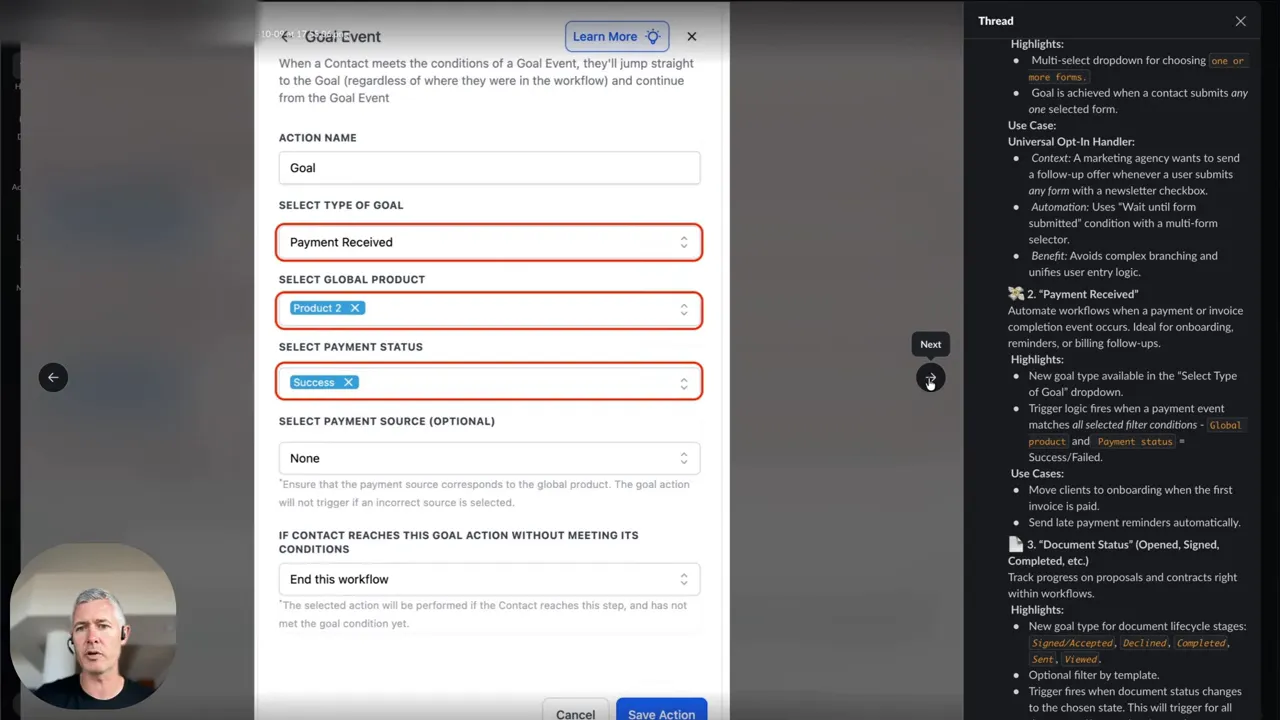
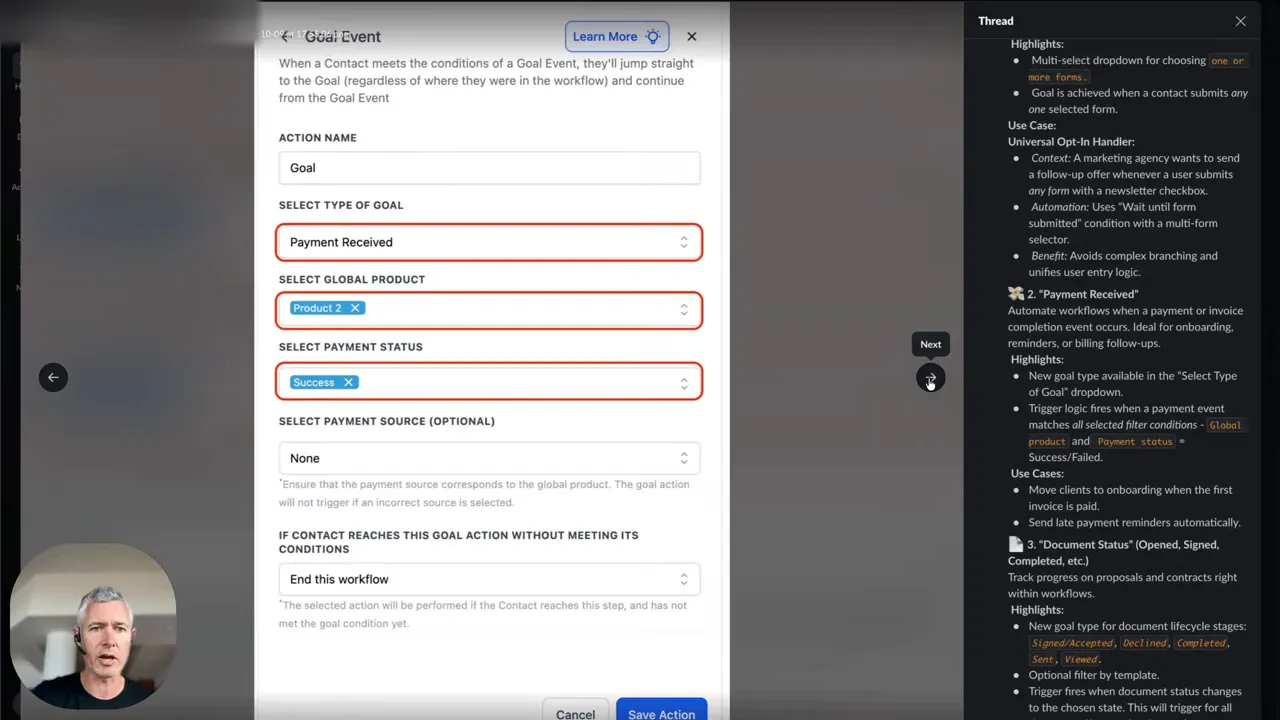
Sean called out “payment received” as a goal type. That’s critical for e-commerce operations and service businesses. By treating payment as a goal event, your funnels can stop promotional sequences once a purchase completes and pivot into post-purchase nurturing and upsell flows.
- Why this matters: When payments trigger goals, you avoid sending purchase reminders to customers who already bought — and you open immediate opportunities for cross-sells.
- Actionable takeaway: Use payment-received triggers to move customers from prospect sequences into onboarding and retention tracks.
Stat to remember: Automated post-purchase flows can increase repeat purchase rates by up to 20% when they contain personalized recommendations and timely incentives.
CTA: E-commerce entrepreneurs, build payment-aware funnels with GFunnel’s payment integration and move buyers into nurturing tracks automatically.
Closing documents and proposals with document status goals
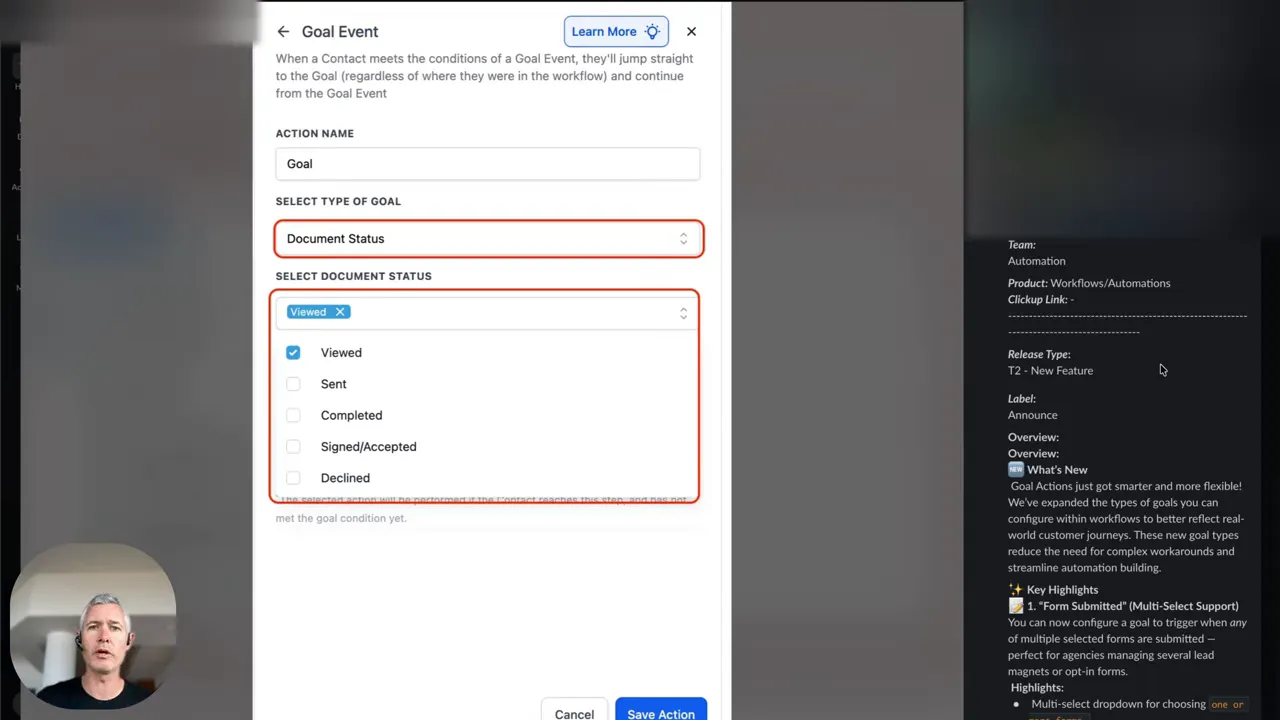
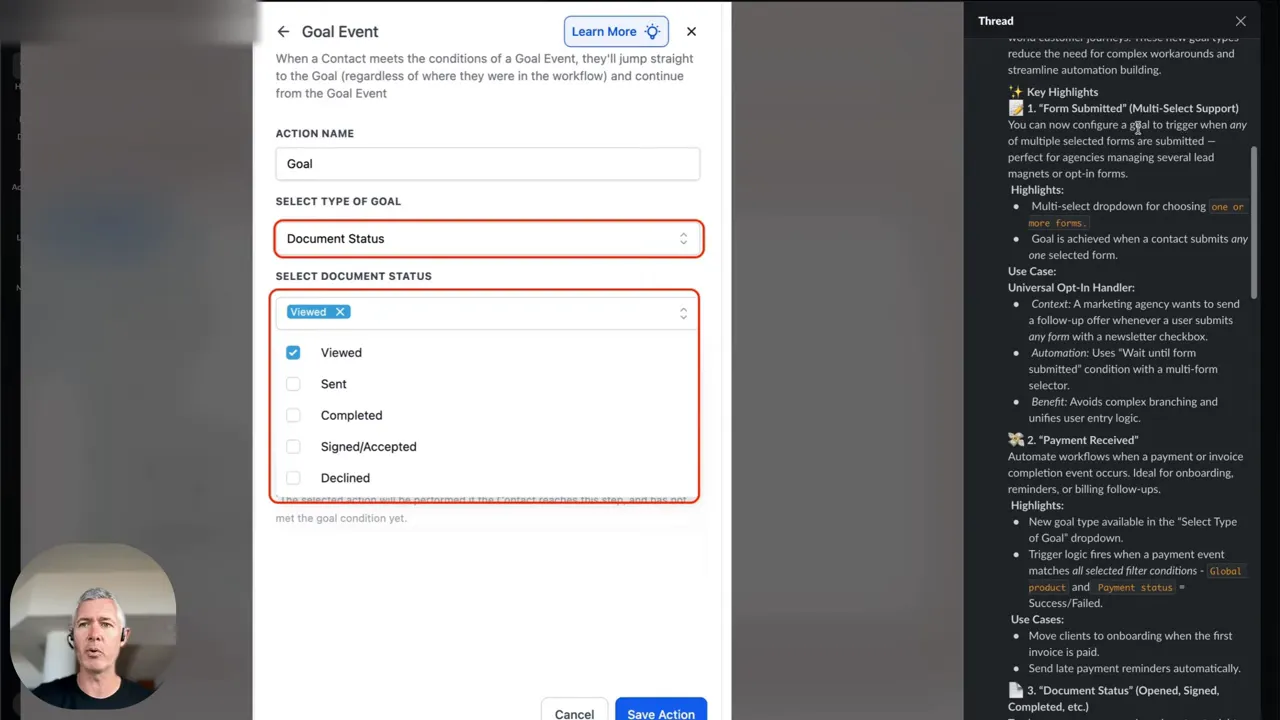
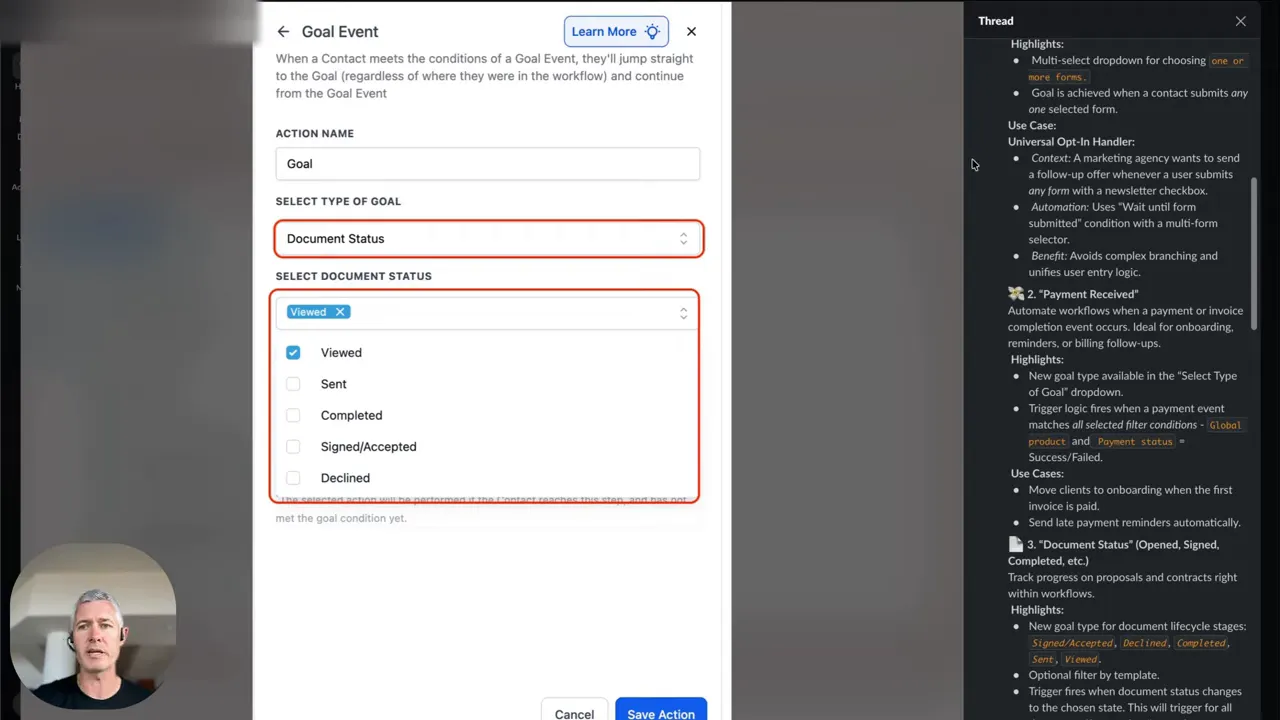
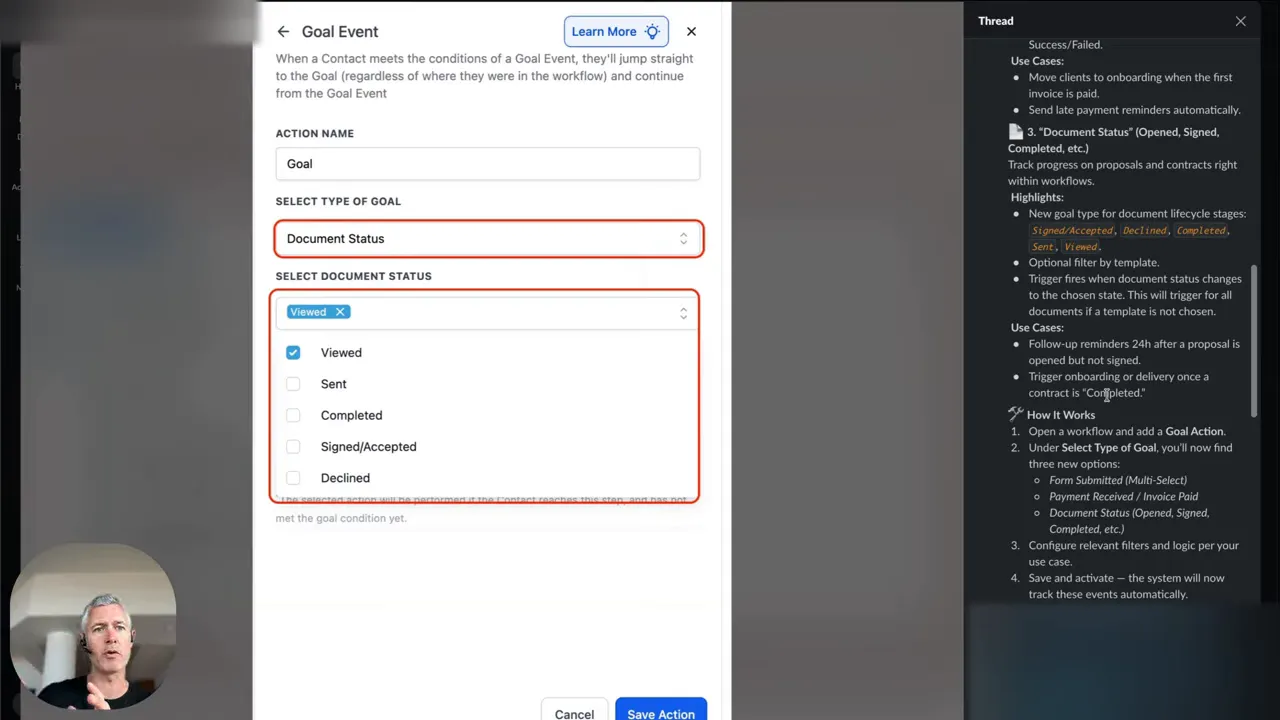
Another practical goal type Sean mentioned is document status (open, signed, completed). For service businesses, agencies, and B2B sellers, tracking proposal status natively inside your funnel is a game-changer. You can trigger reminders if a proposal is opened but not signed, and immediately pivot workflows when a contract is signed.
- Why this matters: Using document status as a goal reduces the back-and-forth and accelerates deal close rates.
- Actionable takeaway: Configure workflows to wait for a document to be signed, then trigger onboarding and billing sequences upon completion.
CTA: Service providers, automate your proposals and onboarding with GFunnel’s document-aware goal logic.
Simplifying complex logic with event-driven goals
One of the most valuable messages in Sean’s update is the simplification of logic. Instead of writing elaborate conditions and branching, goals let a workflow “observe” and react. This decreases maintenance overhead and reduces the chance for misconfigured sequences that annoy prospects.
- Why this matters: Simpler automation is more reliable, and faster to iterate and scale.
- Actionable takeaway: Replace intricate nested conditions with clear goal events that represent real milestones in the customer journey.
CTA: Entrepreneurs, simplify your funnels with GFunnel’s goal events and build reliable, scalable automation.
GFunnel’s ecosystem solutions: Mapping themes to platform features
Small business owners, scale faster by mapping these video-driven themes to GFunnel’s features. Below I’ll walk through each theme and explain which GFunnel tools solve the problem, with measurable benefits and practical examples.
GFunnel’s Automation for Event-Driven Funnels
GFunnel’s automation engine lets you build workflows that pause, wait, and react to real events — form submissions, payments, or document signatures. Instead of relying on time delays or external scripts, the automation tracks internal state and pushes contacts through goal-aware paths.
- Feature highlight: Workflow goal events (form submission, payment received, document status).
- Benefit: Up to 50% less manual work for teams handling lead follow-up and onboarding.
- Metric: Typical customers see a 20% boost in conversion rates after reworking funnels from time-based to event-driven logic.
Example use: When a prospect checks a “newsletter” box on any form, GFunnel’s automation detects that multi-select input and triggers a targeted email series designed for subscribers. If the user later purchases, the system recognizes the payment and stops the subscriber sequence immediately, switching to a post-purchase onboarding flow.
CTA: Explore GFunnel’s automation features: https://www.gfunnel.com/automation-home
GFunnel’s Lead Connector and CRM for Seamless Follow-Up
Lead Connector with GFunnel is the CRM backbone that tracks contacts across funnel stages and stores the events that trigger goal transitions. The CRM is designed to be your lead database, communication hub, and action center.
- Feature highlight: Lead Connector CRM integrated with workflow goal events and funnels.
- Benefit: Single source of truth for customer state, campaigns, and revenue events.
- Metric: Businesses report more accurate nurturing and fewer lost opportunities when using an integrated CRM vs. disconnected tools.
Practical benefit: When a payment is received or a document is signed, Lead Connector updates contact status and immediately informs automation rules without manual syncing.
CTA: Learn more about Lead Connector and the GFunnel CRM: https://www.gfunnel.com/crm
GFunnel’s Funnels & Fast Autosave for Productivity and Reliability
GFunnel’s drag-and-drop funnel builder is built for speed and reliability. One technical advantage is the dedicated web worker autosave that reduces save times from roughly 2.8 seconds to 103ms — about 28x faster. Faster autosave matters when teams collaborate, edit live funnels, or worry about losing progress.
- Feature highlight: Drag-and-drop funnel builder with web worker autosave (103ms).
- Benefit: Less friction in building marketing funnels and fewer lost edits.
- Metric: Faster editing translates to faster iteration cycles and quicker funnel launches.
Example use: Teams can edit landing pages and funnel steps concurrently without overwriting each other or losing changes — perfect for agile teams rolling out A/B tests.
CTA: Build marketing funnels faster with GFunnel’s funnel builder: https://www.gfunnel.com/funnel-home
GFunnel’s Real-Time Analytics and Conversion Insights
Real-time analytics are essential for optimizing marketing funnels. GFunnel provides dashboards that show engagement, payments, conversion rates, and funnel drop-offs — all in one place. This aligns with the idea of reacting to goals: when analytics show a drop at a particular stage, you can update goal logic or messaging quickly.
- Feature highlight: Real-time dashboards and funnel performance metrics.
- Benefit: Immediate visibility into where prospects stall and where to focus optimization.
- Metric: Using real-time analytics, teams can decrease funnel drop-off by 15–30% over iterative campaigns.
Example use: Monitor a funnel where prospects often fail to sign a proposal; then add a goal-driven sequence that triggers reminders based on document status and adjusts messaging depending on whether the document has been opened or ignored.
CTA: View GFunnel’s analytics capabilities: https://www.gfunnel.com
GFunnel’s Community Networking for Growth and Mentorship
Business growth is not only technical — it’s social. GFunnel emphasizes niche communities (SaaS founders, e-commerce pros, restaurant owners) where entrepreneurs share strategies, templates, and partnerships. This networking component complements funnel optimization because it accelerates learning and referrals.
- Feature highlight: Niche communities and group discussions for business collaboration.
- Benefit: Faster access to tested funnel templates and insights that reduce experimentation time.
- Metric: Businesses in active communities often report doubling referral-driven leads within months of engagement.
Example use: A new e-commerce owner joins the E-commerce Pros community, adopts a member-shared funnel template, and customizes GFunnel’s payment-triggered sequences to drive revenue in weeks instead of months.
CTA: Connect with GFunnel’s communities: https://www.gfunnel.com/communities
GFunnel’s E-commerce & Payment Integration for Smooth Transactions
GFunnel integrates payment processing so that “payment received” can be used as a native event within workflows. For online stores, this eliminates external scripts and ensures that transactional data is captured promptly and used to pivot funnels.
- Feature highlight: Built-in payment processing and e-commerce tools.
- Benefit: Reduced friction at checkout and immediate post-purchase engagement.
- Metric: Payment-aware funnels can increase repeat purchases by 20% with tailored post-purchase nurture.
CTA: Learn about GFunnel’s e-commerce capabilities: https://www.gfunnel.com
Real-world applications: Two case studies
Small business owners, scale your business by applying these ideas to concrete scenarios. Below are two case studies — one e-commerce store and one restaurant — showing how event-driven goals, payment integration, and community support combine to deliver growth.
Case study 1: Boutique e-commerce store — turning visitors into repeat buyers
Scenario: A boutique selling specialty home goods struggled with abandoned carts and low repeat purchases. Marketing campaigns drove traffic, but the checkout experience felt disconnected from post-purchase communication. The team wanted a solution that required minimal manual oversight.
Solution implemented with GFunnel:
- Built a conversion-focused marketing funnel using the drag-and-drop builder for product landing pages and checkout flow (fast autosave made teamwork seamless).
- Configured form goals for newsletter signups and multi-select product interests so the automation could send relevant content.
- Set a payment-received goal to stop promotional sequences and trigger a post-purchase onboarding and product-care series.
- Used real-time analytics to monitor where prospects dropped off and iterated landing pages quickly.
- Joined GFunnel’s E-commerce Pros community to borrow tested templates and CRO tips.
Results:
- Abandoned cart recovery improved by 28% after introducing payment-aware and abandonment-triggered sequences.
- Repeat purchase rate increased by 17% within three months due to targeted post-purchase offers and loyalty prompts.
- Team time spent on manual follow-ups decreased by 45%.
"GFunnel’s automation saved us hours every week and the community templates gave us a jump start. We launched a new funnel in days, not weeks." — Boutique Owner
CTA: Build similar funnels with GFunnel’s funnel builder and automation: https://www.gfunnel.com/funnel-home
Case study 2: Local restaurant chain — reservations, orders, and loyalty
Scenario: A small restaurant chain needed to streamline online ordering, capture customer data, and run segmented offers to drive repeat dining. They used multiple disconnected tools for orders, CRM, and email, which led to missed opportunities and manual syncs.
Solution implemented with GFunnel:
- Integrated online ordering and payment processing into GFunnel, so orders and payments became native events.
- Used form-submitted goals to capture customer preferences (e.g., delivery vs. pickup, dietary preferences) via multi-select fields.
- Set document status goals for catering proposals and tracked signed agreements for corporate accounts.
- Applied real-time analytics to identify high-performing promotions and fast-moving menu items.
- Joined the restaurant ecosystem discussions and used Call Net Capture features for offline-to-online conversions.
Results:
- Reservations and online orders increased by 30% after consolidating tools and automating confirmations.
- Manual phone follow-up for catering decreased by 60% as GFunnel triggers handled signed proposals and payments.
- Customer lifetime value improved due to targeted loyalty offers and accurate segmentation.
"GFunnel helped us centralize orders and follow-ups. Our managers love the real-time dashboards — we can respond to demand spikes within minutes." — Restaurant Manager
CTA: Restaurants, explore GFunnel’s restaurant tools and community: https://www.gfunnel.com
Why GFunnel leads: All-in-one vs. patchwork solutions
Small business owners, choose a platform that brings funnels, CRM, payments, automation, and community into one system. Below are the top reasons GFunnel outpaces competitors who offer fragmented tools.
- Unified data model: Events like payments and document signatures are native, preventing sync errors and lag.
- Speed and reliability: Fast autosave (103ms) reduces lost work and supports collaborative editing.
- Built-in networking: Niche communities accelerate learning and provide ready-made templates.
- Affordability and scalability: Plans designed for small businesses through enterprises.
Comparison: Traditional Business Tools vs. GFunnel’s Ecosystem
Caption: Traditional Business Tools vs. GFunnel’s Ecosystem
CTA: Compare plans and see which GFunnel option fits your business: https://www.gfunnel.com/create-account
Implementation checklist: Turn insights into action this week
Small business owners, follow this practical checklist to implement event-driven, goal-aware marketing funnels with GFunnel in 7 days or less.
- Audit your funnels: Identify where time-based logic can be replaced by event-based goals (forms, payments, documents).
- Create multi-select form fields to capture user preferences and use them for segmentation.
- Set up payment integration so "payment received" becomes a native goal event.
- Configure document tracking for proposals and contracts; add reminders based on document status.
- Enable real-time analytics dashboards to monitor funnel drop-offs and experiment quickly.
- Join a GFunnel community relevant to your niche to borrow templates and best practices.
- Run an A/B test on your highest-traffic funnel stage and iterate based on live data.
CTA: Get started with a free trial and the templates you need: https://www.gfunnel.com
Interactive element and community call
Test your growth potential today — try the "Test Your Business Growth Potential" quiz inside GFunnel to get a tailored roadmap. Then, join a relevant community (E-commerce Pros, SaaS Founders, Restaurant Owners) to accelerate implementation.
Community call: Connect with E-commerce Pros and other niche groups: https://www.gfunnel.com/communities
Related content
- Scale Restaurants with GFunnel — see restaurant-specific tools and integrations: https://www.gfunnel.com
- Build marketing funnels with GFunnel — start with the drag-and-drop builder and templates: https://www.gfunnel.com/funnel-home
- Automate business operations with GFunnel — explore automation and integrations: https://www.gfunnel.com/automation-home
Conclusion and call-to-action
Marketing funnels that respond to real events — form submissions, payments, and document signatures — are the modern standard. What Sean outlined about expanded goal types is more than a feature update; it's a reminder that funnels should be goal-aware, responsive, and simple to manage. GFunnel brings that functionality together with a fast, reliable funnel builder, an integrated CRM (Lead Connector), payment and document integrations, real-time analytics, and communities for continuous learning.
If you’re ready to reduce manual work, improve conversion rates, and build funnels that react to customer intent, GFunnel is designed to be your all-in-one business platform. Start with a free account, explore automation templates, plug in payment triggers, and join a community to accelerate results.
Start building smarter marketing funnels and grow with GFunnel: https://www.gfunnel.com
FAQs
Additional resources and links
GFunnel homepage: https://www.gfunnel.com
Automation features: https://www.gfunnel.com/automation-home
Funnel builder: https://www.gfunnel.com/funnel-home
Lead Connector & CRM: https://www.gfunnel.com/crm
Create an account and start a free trial: https://www.gfunnel.com/create-account
Explore communities: https://www.gfunnel.com/communities
Sources and further reading
- HubSpot’s guide on funnel optimization and stages — recommended for deeper funnel theory and optimization strategies.
- Neil Patel’s articles on sales funnels and conversion tactics — practical tips for testing landing pages and email sequences.
- GFunnel feature descriptions and platform guides (internal resources referenced above).