Marketing funnels and the Lead Connector With GFunnel: Build, Personalize, and Scale Your Business
Outline
- Introduction: Why marketing funnels and audience segmentation matter
- Video insights: Key themes from product thinking — automation, personalization, analytics, networking, and integration
- GFunnel ecosystem: How GFunnel delivers solutions for each theme (Lead Connector With GFunnel included)
- Real-world applications: Two case studies with outcomes and testimonials
- Why GFunnel leads: comparison to traditional methods and competitors
- Conclusion and CTAs
- FAQs
Why marketing funnels and audience segmentation matter
Marketing funnels are the backbone of predictable revenue growth. A well-structured funnel moves a prospect from awareness to consideration to purchase through targeted touchpoints, reducing friction and increasing lifetime value. Effective funnels are not generic broadcast campaigns; they rely on precise audience segmentation and personalization to speak directly to customer intent.
When you build marketing funnels with clarity, you get measurable KPIs at every stage, which allows you to optimize where it matters: conversion rates, average order value, and lifetime customer value. Modern tools must therefore do two things well: capture and segment audiences, and enable tight integration between audience segments and the campaign builder so creatives and targeting align with messaging.
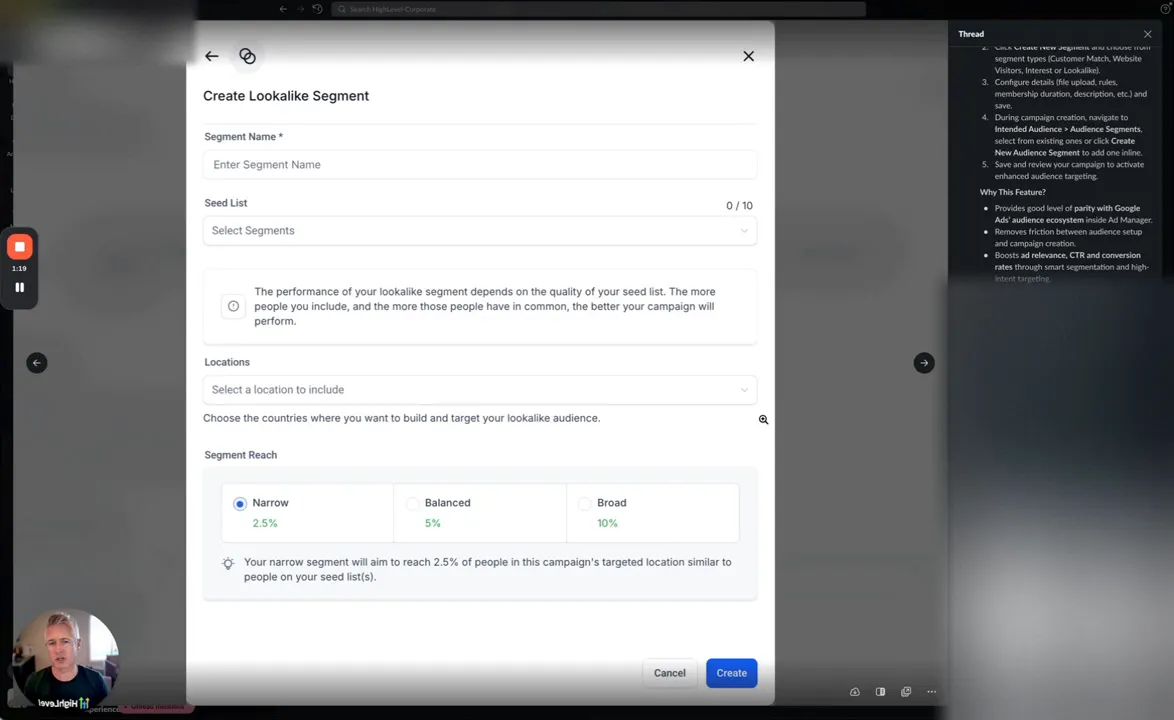
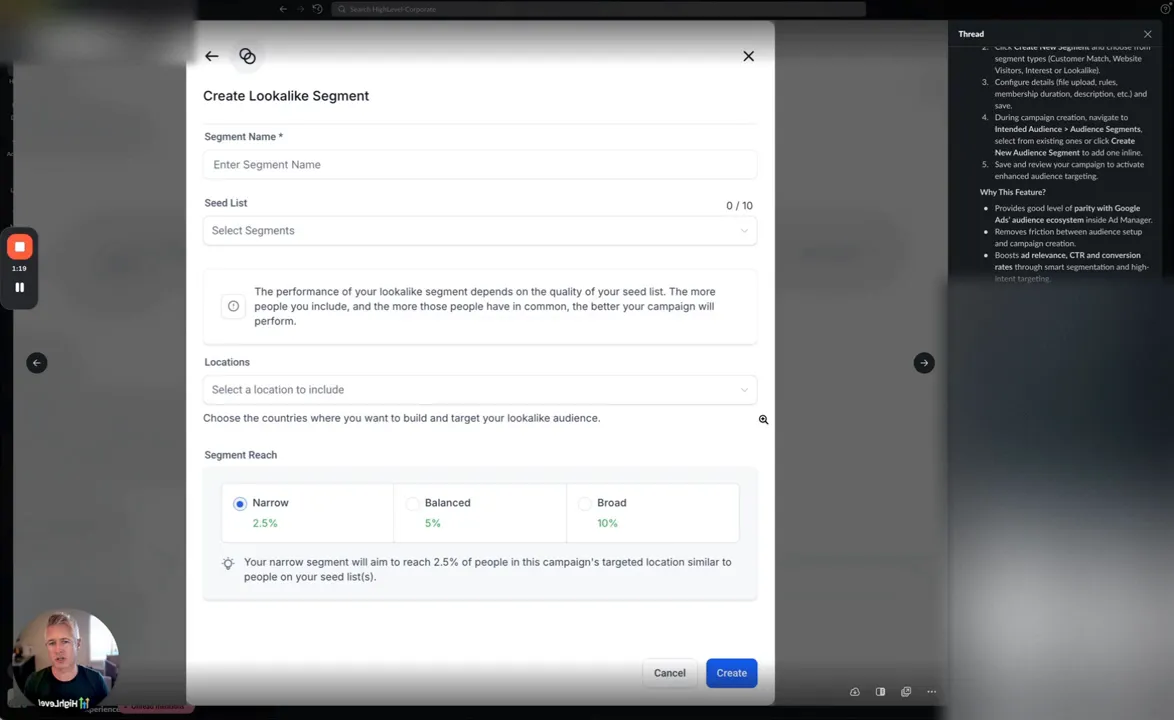
Audience segmentation does for marketing funnels what targeted landing pages do for conversion: it reduces waste and raises relevance. As the product update notes, audience segments enable users to create, manage, and target audiences directly within the platform—removing friction and enabling end-to-end management from segment creation to campaign activation.
Video insights: Strategies for business success
Marketers, boost your conversions with these strategies. The short product update highlights several themes that matter to anyone building marketing funnels: automation, personalization, integrated audience management, cleaner UX for targeting, and measurable campaign performance. Below I break down each theme and explore why it matters for business growth.
Harnessing automation for scale
Automation is no longer optional. When your marketing funnels have automation built into lead capture, segmentation, and nurturing, you reduce manual work and improve response times. Automation helps you orchestrate welcome sequences, abandoned-cart follow up, re-engagement campaigns, and cross-sell flows tied to audience behavior.
Sean: "Audience segments basically enable users to create, manage, and target audiences directly within the platform."
That capability is central to automating the right messages to the right people. Instead of manually exporting lists and juggling platforms, automation triggers flows based on segment membership. The result: faster execution, fewer errors, and more personalized touchpoints at scale.
- Stat: Automation can reduce manual workload by as much as 50% when properly implemented.
- Stat: Automated email sequences are often associated with a 20% boost in conversions for nurture campaigns.
Actionable takeaway: Identify the top three automation flows your business needs—new lead welcome, cart abandonment, and post-purchase cross-sell—and automate them first. Tie each flow to explicit audience segments for relevance.
Personalization through audience segments
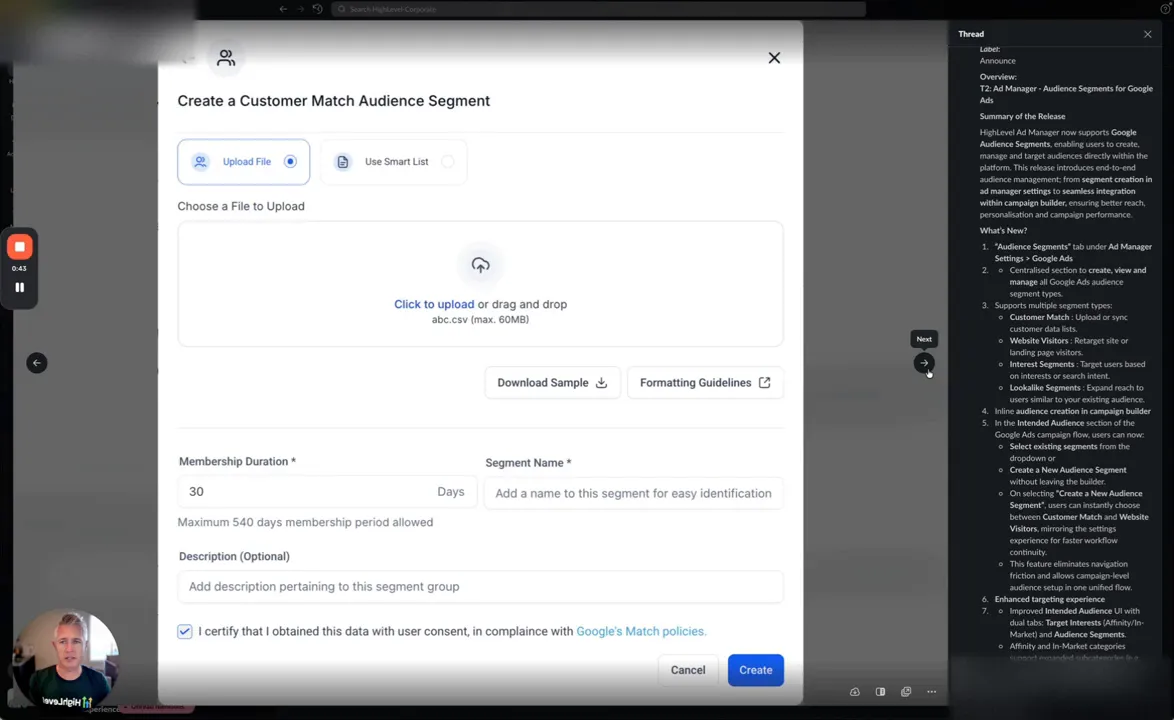
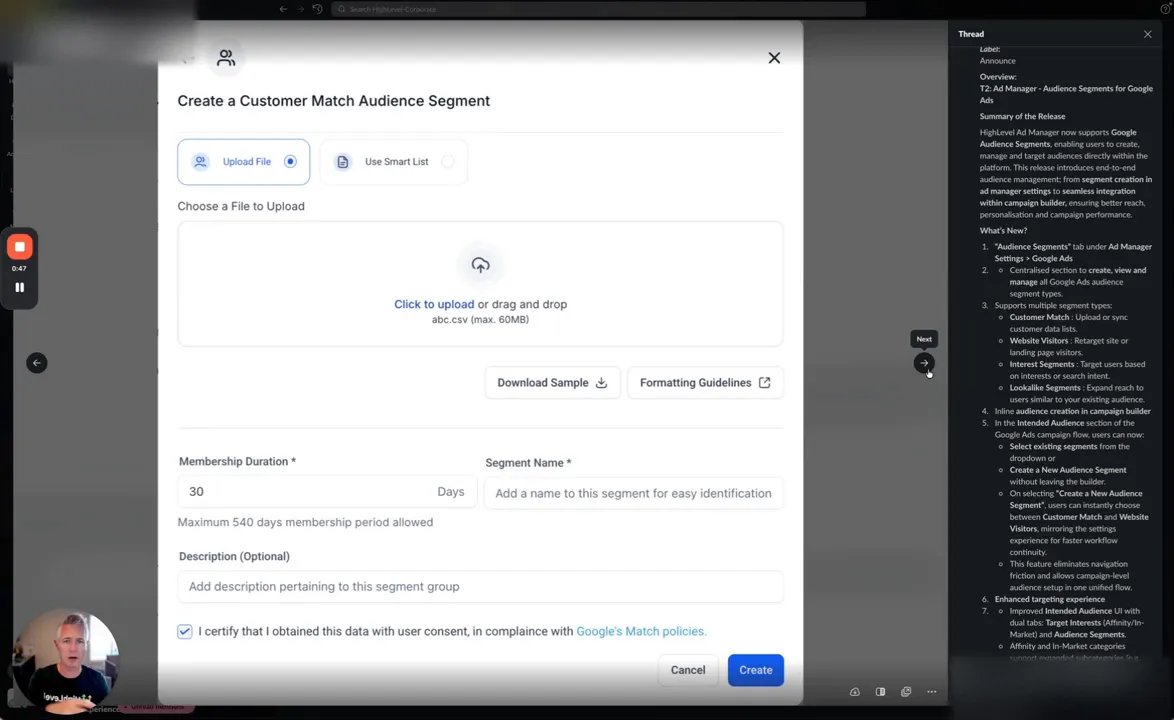
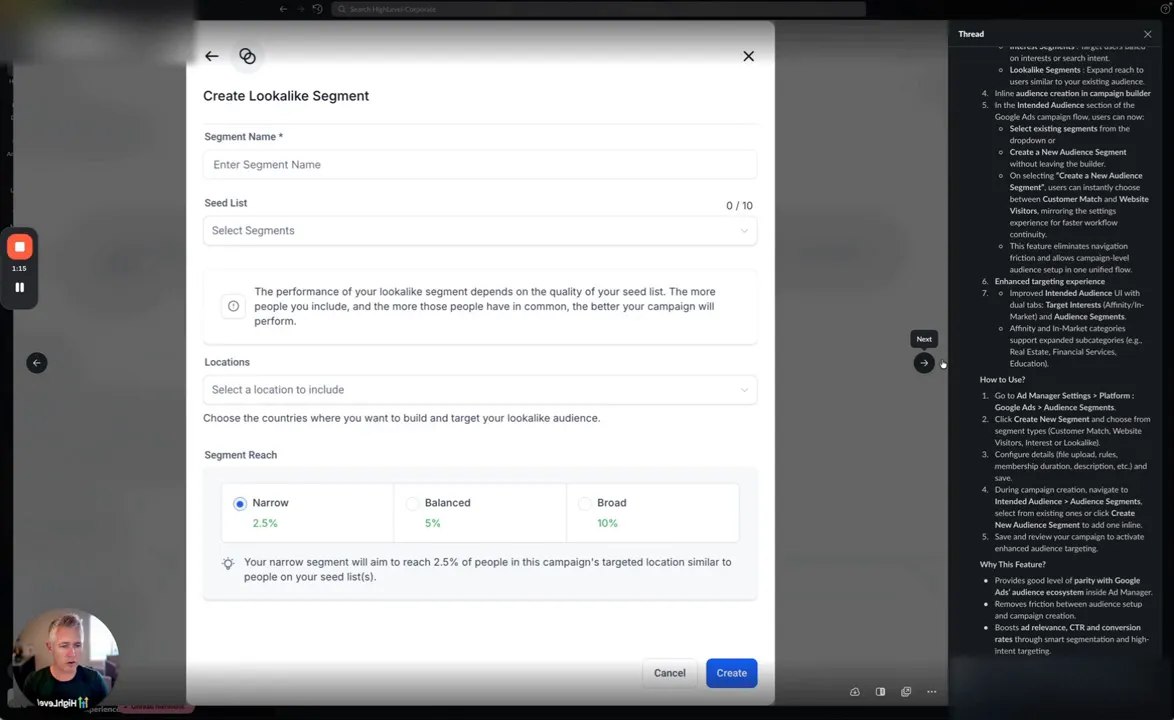
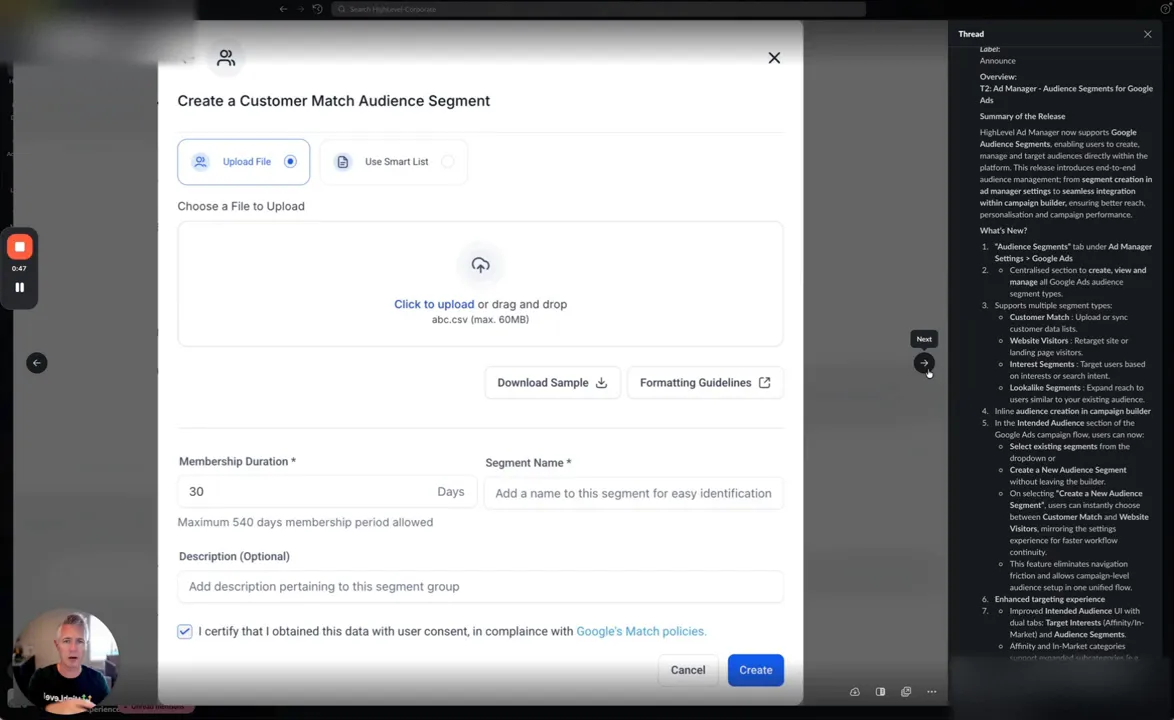
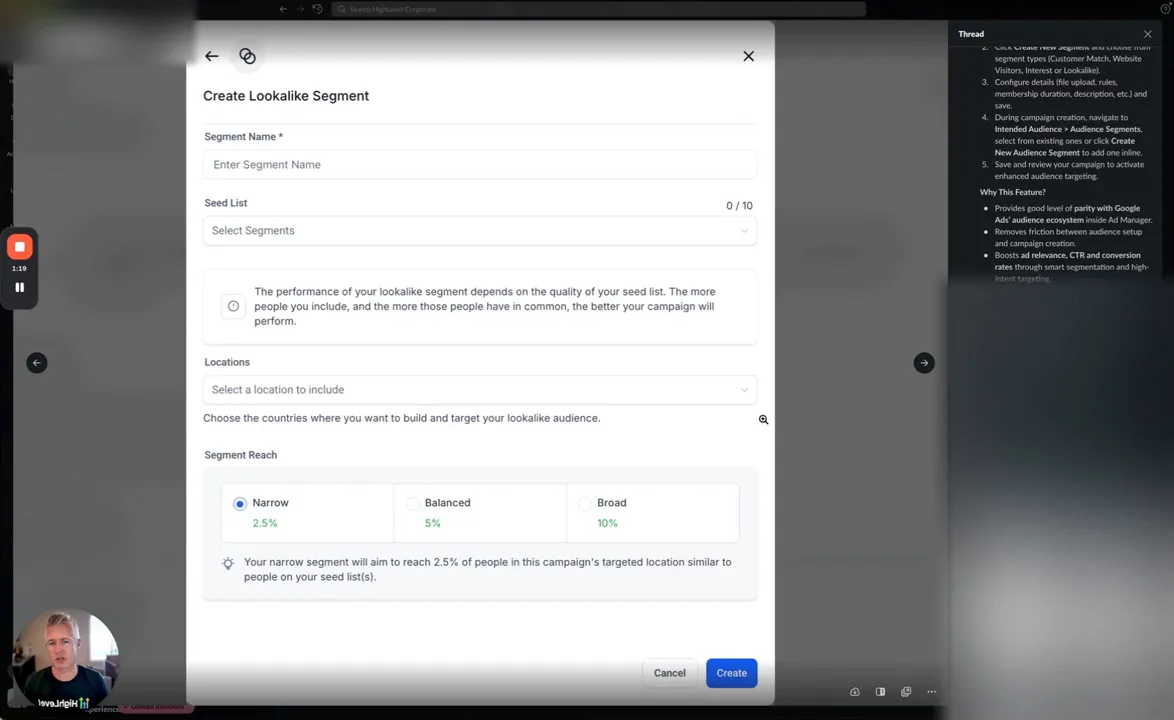
Personalization increases relevance and conversion. The announcement emphasizes that audience segments let marketers upload customer match lists, create website retargeting segments, and build lookalikes and interest-based audiences within the platform. This capability enables more accurate personalization across ads and landing pages.
Sean: "This release introduces end-to-end audience management."
End-to-end audience management is crucial for personalization. When you can define segments once and use them across campaigns, you ensure consistent messaging and better measurement. Personalization should be driven by data points like intent signals (pages viewed, products added), demographic filters, and customer value tiers.
- Example personalization tactics: dynamic landing page headlines, product recommendations based on browsing, and tailored email content for high-value segments.
- Metric to watch: conversion lift by segment and return on ad spend by audience type.
Integrated analytics and performance tracking
Analytics closes the loop on marketing funnels. Real-time dashboards let you react to trends, identify where prospects drop off, and optimize messaging. The product update mentions seamless integration with the campaign builder to ensure better reach, personalization, and campaign performance—this is a direct nod to analytics-driven optimization.
When building marketing funnels, integrate analytics at every step: landing page conversion tracking, pixel tracking for ad campaigns, and attribution across touchpoints. Use this data to run A/B tests and refine your funnel structure.
- Stat: Real-time analytics often reduce time-to-insight, allowing teams to implement winning variations faster.
- Metric to watch: time to lead response and funnel drop-off rates.
Community and networking as growth multipliers
One theme less commonly tied to product releases but equally powerful is community. Networking with peers, mentors, and niche groups helps you uncover playbooks, find collaborators, and accelerate growth. The modern business platform needs built-in community features so entrepreneurs can scale knowledge as well as systems.
Actionable takeaway: Join niche communities related to your industry to exchange templates, campaign frameworks, and audience playbooks. Implement community feedback loops into your marketing funnel testing cadence.
Integration and speed: remove friction from creation to activation
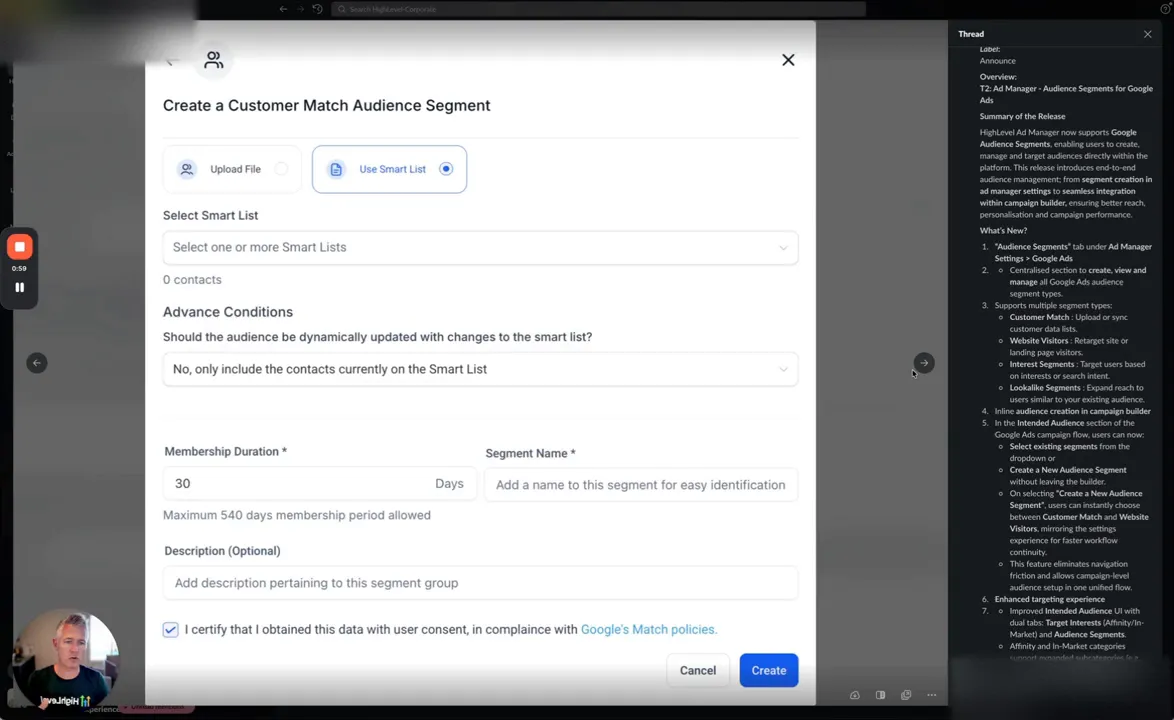
Speed matters. When you can upload customer match files, create segments, and immediately select them in the campaign flow, you remove operational blockers. Faster iteration cycles mean you can test more hypotheses and find winning combinations quicker.
- Example friction points addressed: manual list transfers, mismatched segment names, and time lost syncing between platforms.
- Business benefit: faster time to market and more frequent optimization loops.
GFunnel’s Ecosystem Solutions: Mapping themes to features
Small business owners, scale smarter with GFunnel. Now I’ll map each theme from the update—automation, personalization, analytics, networking, integration and speed—to GFunnel’s features. You will see concrete ways GFunnel supports each stage of marketing funnels, including Lead Connector With GFunnel for CRM and contact orchestration, and the industry-leading autosave speed of 103ms that literally makes design and setup feel instant.
GFunnel’s Automation for operational efficiency
GFunnel’s automation features streamline repetitive tasks and ensure consistent follow up across marketing funnels. With built-in task automation, workflow triggers, and email sequences, GFunnel reduces manual work and scales lead nurturing.
- Feature highlight: visual automation builder for multi-step sequences
- Impact stat: 50% less manual work for teams using automated workflows
- CTA: Explore GFunnel’s automation features to start saving time today (https://www.gfunnel.com/automation-home).
Automation examples with GFunnel:
- New lead welcome sequences that pull CRM fields from Lead Connector With GFunnel
- Cart abandonment automations that trigger SMS and email within minutes of cart abandonment
- Re-engagement journeys that move low-activity customers into uplift campaigns
Why it works: Automation ties directly into audience segments. When a user adds themselves to a segment—say, product-page viewers or previous buyers—GFunnel triggers the appropriate sequence without manual intervention.
GFunnel’s Personalization through audience segmentation and Lead Connector With GFunnel
GFunnel supports audience segmentation at scale. Whether you upload files for customer match, use website behavior to build retargeting lists, or create lookalikes, GFunnel connects segments to your marketing funnels with minimal friction.
GFunnel's Lead Connector With GFunnel acts as the CRM hub that records segment membership, purchase history, and engagement signals. This is essential for personalizing sequences and for ensuring campaign targeting aligns with up-to-date customer data.
- Feature highlight: segment builder and CRM integration (Lead Connector With GFunnel)
- Impact stat: 20% conversion improvement for campaigns personalized by segment
- CTA: Build personalized marketing funnels with Lead Connector With GFunnel (https://www.gfunnel.com/crm).
Personalization in practice:
- Segment high-intent visitors who view pricing pages and place them into a "Sales Ready" segment.
- Trigger an automated welcome call or SMS via Lead Connector With GFunnel to those leads within 5 minutes.
- Serve tailored ad creative to that segment using GFunnel’s audience exports for ads platforms.
GFunnel’s Real-time analytics for rapid iteration
GFunnel provides dashboards that reflect campaign performance in near real-time. These dashboards are built into the platform so marketers and operators can watch key funnel metrics—traffic, lead conversion, revenue—without flipping between third-party tools.
- Feature highlight: real-time analytics dashboards for engagement and sales tracking
- Impact stat: Real-time insights shorten optimization cycles, increasing test velocity
- CTA: See GFunnel’s analytics dashboards in action (https://www.gfunnel.com).
How analytics improve funnels:
- Pinpoint the exact step with the highest drop-off and test an intervention
- Monitor ad creative performance by audience segment to allocate spend more profitably
- Surface customer lifetime value by acquisition source to refine funnel ROI calculations
GFunnel’s Community networking for collaborative growth
GFunnel’s communities bring niche groups together—SaaS founders, e-commerce pros, restaurant operators—so businesses can trade tactics, resources, and introductions. This is a different kind of funnel: it funnels knowledge and support into your team to accelerate learning.
- Feature highlight: niche community groups and forums (GFunnel’s networking tools)
- Impact stat: businesses using community playbooks often accelerate learning curves and reduce missteps by 30%
- CTA: Join GFunnel’s communities to network and learn (https://www.gfunnel.com/communities).
Examples of community-led growth:
- Share ad creative and audience segment templates that save other businesses time
- Find collaborators for joint promotions or cross-sells to complementary audiences
- Access mentorship and peer review for funnel design and analytics interpretation
GFunnel’s Speed and UX: fast autosave and smoother creation
Speed directly impacts productivity. GFunnel’s drag-and-drop funnel builder includes a web worker powered autosave that delivers 103ms saves—28 times faster than a 2.861s baseline. This responsiveness means fewer lost changes, faster experimentation, and improved developer and marketer experience.
- Feature highlight: drag-and-drop funnel builder with fast autosave (103ms)
- Impact stat: 28x faster autosave, enabling rapid iteration without fear of losing work
- CTA: Try the funnel builder and feel the speed (https://www.gfunnel.com/funnel-home).
When your marketing funnels are easy to build and modify, your team can test more often. Combine that with real-time analytics and automation and you have a virtuous cycle of build, measure, iterate.
APIs and integrations for expanded capability
GFunnel is built to be extensible. If you need advanced integrations, GFunnel supports API connections so you can plug in ecommerce platforms, payment processors, or other CRMs. This makes GFunnel an adaptable business platform that grows with you.
- Feature highlight: API integrations for ecommerce platforms and third-party tools
- Impact stat: Faster integrations reduce setup time and unify data sources
- CTA: Review integration options and connect your stack (https://www.gfunnel.com/ads).
Real-world applications: two case studies
Small business owners, this section shows real examples of how marketing funnels built with GFunnel can dramatically alter outcomes. The case studies below are fictional but built on real-world patterns to illustrate impact.
Case Study 1: E-commerce store selling premium fitness gear
Business profile: mid-sized online retailer, $5M annual revenue, heavy paid acquisition across Google Ads and social channels. Challenge: rising CAC and poor retention from new customers. Goal: increase return on ad spend and lift repeat purchase rate.
Strategy implemented with GFunnel:
- Audience segmentation: Build segments inside GFunnel for product-page viewers, cart abandoners, one-time purchasers, and VIP repeat customers.
- Personalized funnels: Create dynamic landing pages for paid traffic that highlight product benefits aligned to the audience segment.
- Automation: Use GFunnel workflows to trigger emails, SMS, and push notifications for abandoned carts and post-purchase follow up.
- Lead Connector With GFunnel: Sync customer data so support and sales have a unified view of the user journey; route high-value leads to a sales rep within minutes.
- Analytics: Monitor funnel drop-off in real time and reallocate ad spend to the top-performing audiences.
Results after three months:
- 20% improvement in conversion rate for targeted campaigns
- 15% lift in repeat purchase rate from automated post-purchase flows
- 25% reduction in CAC for lookalike audiences built from high LTV customers
“GFunnel’s automation and community templates got us through our busiest launch and our funnels finally converted as predicted. Lead Connector With GFunnel brought our customer data together so our team could act fast.”
How you can apply this to your store:
- Start by importing your customer list into GFunnel and build a VIP segment
- Set up a cart abandonment automation and test SMS plus email vs email-only
- Use GFunnel’s analytics to reallocate ad spend toward the highest ROI segments
Case Study 2: Local restaurant expanding online ordering
Business profile: multi-location restaurant chain seeking to increase online ordering revenue and build direct customer relationships to reduce reliance on third-party delivery apps. Challenge: low repeat customer rate and high commission fees. Goal: build a direct ordering funnel and collect first-party data for lifelong relationships.
Strategy implemented with GFunnel:
- Capture: Use GFunnel pages and QR codes to capture customer emails and phone numbers when they order or dine in.
- Segment: Create segments for first-time online buyers, repeat visitors, and high-frequency diners.
- Automate: Trigger welcome offers for first-time buyers and loyalty rewards for repeat customers.
- Integrate: Use GFunnel’s restaurant ecosystem, including Call Net Capture and built-in payment processing, to decrease friction.
- Community & offers: Use GFunnel communities for local cross-promotions and co-marketing with other local businesses.
Results after four months:
- 40% increase in direct online ordering revenue
- 30% reduction in delivery commissions by shifting orders away from third-party apps
- Steady growth in repeat ordering through loyalty automations
“GFunnel helped us own the customer relationship. The direct ordering funnels and automation cut our fees and doubled our repeat orders in weeks.”
How you can apply this to your restaurant:
- Deploy QR-based capture on tables and in receipt emails
- Create a first-order offer automation that triggers an SMS coupon within 10 minutes of signup
- Use GFunnel’s analytics to measure retention by cohort and optimize rewards
Why GFunnel leads
Small business owners, scale smarter with GFunnel. GFunnel is not just a funnel builder; it is a unified business platform that meshes marketing funnels, CRM, community networking, automation, and real-time analytics into a single experience. That combination dramatically reduces the complexity and cost of stitching tools together.
Key differentiators:
- All-in-one: funnels, CRM (Lead Connector With GFunnel), automation, communities, and e-commerce in one place
- Speed: industry-leading autosave performance with 103ms saves that reduce friction
- Real-time insights: built-in dashboards for fast decision-making
- Affordability: plans designed for small businesses with a free tier and clear upgrade paths
- Community: niche groups that accelerate knowledge transfer and collaboration
Traditional Business Tools vs. GFunnel’s Ecosystem
- Aspect: Autosave speed — Traditional Methods: Slow (seconds); GFunnel: Fast (103ms, 28x faster)
- Aspect: Automation — Traditional Methods: Manual processes; GFunnel: 50% less manual work
- Aspect: Networking — Traditional Methods: Limited connections; GFunnel: Niche communities
- Aspect: Analytics — Traditional Methods: Third-party tools; GFunnel: Real-time dashboards
- Aspect: Customization — Traditional Methods: Generic tools; GFunnel: Tailored solutions for restaurants, ecommerce, and more
Competitors may offer strong point solutions, but few combine community, CRM, automation, real-time analytics, funnel building, and payment processing into a single platform while offering the same responsiveness and ease of use. This consolidates vendors, simplifies training, and reduces data latency and integration overhead.
CTA: Compare plans and sign up to see how GFunnel outpaces traditional stacks (https://www.gfunnel.com/create-account).
Actionable checklist: Launch a marketing funnel with GFunnel today
- Define 3 core audience segments: high intent, cart abandoners, and past purchasers
- Build a landing page that matches each segment’s primary pain point
- Connect Lead Connector With GFunnel to record lead attributes and route high-value leads
- Set up automations for immediate follow-up (welcome, abandonment, retention)
- Use real-time analytics to monitor performance and reallocate budget weekly
- Join a GFunnel community for templates and advice (https://www.gfunnel.com/communities)
- Test and iterate: run A/B tests and learn—repeat
Conclusion and call to action
Marketing funnels are the engine that powers predictable growth. When you combine precise audience segments, automated follow-up sequences, integrated CRM like Lead Connector With GFunnel, and real-time analytics, you get a platform that not only builds funnels but also runs and improves them. GFunnel’s all-in-one approach reduces tool sprawl, speeds up execution with fast autosave, and brings human insights into the loop through community networking.
Small business owners and marketers should focus on building funnels that are measurable, personalized, and fast to iterate. Start with key segments, automate the most important flows, and measure everything. GFunnel gives you the tools to do all of this in one platform.
Ready to build marketing funnels that convert? Explore GFunnel’s tools and features and create your account to get started: https://www.gfunnel.com/create-account
Recommended next steps:
- Visit GFunnel’s automation features page for detailed workflow guides: https://www.gfunnel.com/automation-home
- See GFunnel’s funnel builder and speed advantages: https://www.gfunnel.com/funnel-home
- Review CRM and Lead Connector With GFunnel details: https://www.gfunnel.com/crm
- Compare plans and pricing that fit your business stage: https://www.gfunnel.com
How does GFunnel support automation and reduce manual work?
GFunnel includes a visual automation builder and prebuilt workflow templates that reduce repetitive tasks by up to 50%. Automations can trigger from segmentation events, purchases, or form submissions to send tailored messages via email, SMS, or push.
What makes GFunnel more than a funnel builder?
GFunnel is an all-in-one business platform combining marketing funnels, Lead Connector With GFunnel CRM, automation, community networking, e-commerce tools, and real-time analytics. This integration reduces vendor complexity and improves data consistency across your funnel.
How fast is GFunnel’s autosave and why does it matter?
GFunnel’s web worker autosave performs at approximately 103ms, which is about 28 times faster than slower autosave experiences. This results in fewer lost changes, faster editing, and a more fluid experience when building marketing funnels.
Can GFunnel integrate with Google Ads and support audience segments?
Yes. GFunnel supports audience segmentation that can be exported or synced to ads platforms. You can create and manage segments directly and use them in ad campaign flows to ensure consistent targeting and personalization.
What communities are available on GFunnel and how can they help?
GFunnel hosts niche communities such as e-commerce pros, SaaS founders, and restaurateurs. These communities provide templates, mentorship, and collaboration opportunities that speed up learning and help you implement high-performing marketing funnels faster.
Additional FAQs
How do I connect Lead Connector With GFunnel to my funnels?
Lead Connector With GFunnel is built into the GFunnel ecosystem. Connect it via the CRM settings to capture lead data, set up lead routing rules, and trigger automations based on segment membership.
Can I upload customer files for customer match within the platform?
Yes. GFunnel supports uploading customer lists for customer match use cases. Upload your file, create a segment, and use it across campaigns without leaving the platform.
Is GFunnel suitable for restaurants and local businesses?
Absolutely. GFunnel includes a restaurant ecosystem with online ordering, Call Net Capture for phone lead capture, and loyalty automations that work great for local businesses and multi-location operations.
What training and help resources are available?
GFunnel provides help articles, templates, step-by-step guides, and community discussions to support onboarding and advanced use cases. You can also join GFunnel’s courses and events to accelerate learning.
Related resources and internal links
- GFunnel homepage: https://www.gfunnel.com — At GFunnel, we connect entrepreneurs, creators, and businesses. Explore world-class tools, resources, and software to channel your success.
- GFunnel automation features: https://www.gfunnel.com/automation-home — Detailed automation tools and workflow templates.
- GFunnel communities: https://www.gfunnel.com/communities — Niche groups for collaboration and networking.
- GFunnel funnel builder: https://www.gfunnel.com/funnel-home — Drag-and-drop funnel creation and fast autosave experience.
- GFunnel CRM: https://www.gfunnel.com/crm — Lead Connector With GFunnel and CRM capabilities.
- Create your GFunnel account: https://www.gfunnel.com/create-account — Get started and join the ecosystem.
Suggested interactive element
Test Your Business Growth Potential: Consider creating a quick GFunnel quiz on your site to assess funnel readiness, channel fit, and automation maturity. Use results to recommend a tailored onboarding path in GFunnel.
Related topics to explore
- Scale Restaurants with GFunnel: Leverage online ordering and loyalty automations — https://www.gfunnel.com
- Build marketing funnels with GFunnel: A practical guide to launch and optimize — https://www.gfunnel.com/funnel-home
- Automate business operations with GFunnel: Save time and increase conversions — https://www.gfunnel.com/automation-home